
Ink and Identity: Toward a Literary Renaissance for Palestinian Christians
Article Written By Sammy Kirreh
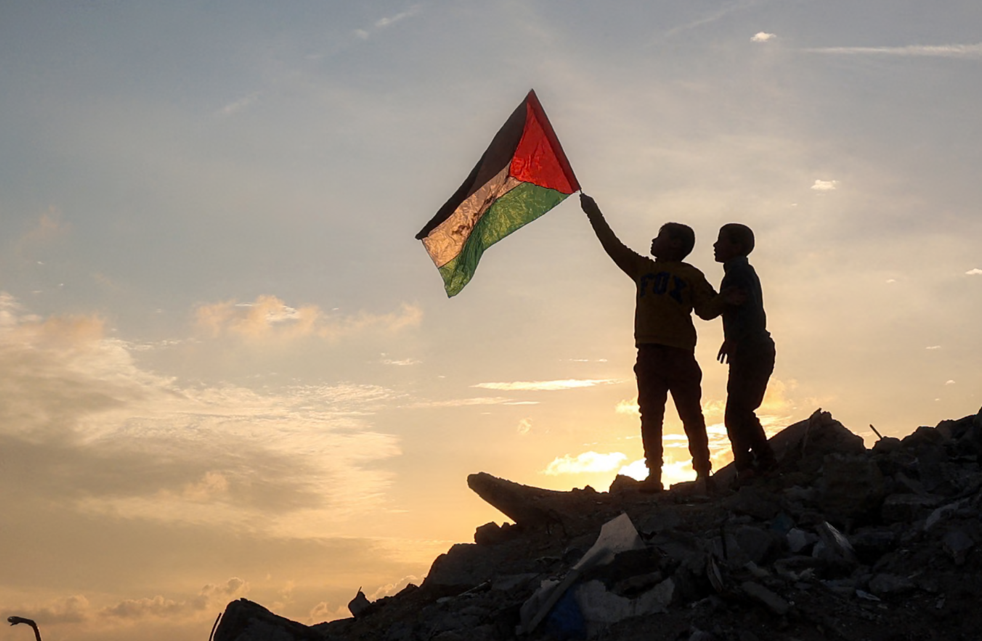
Photo: Eyad Baba/AFP/Getty Images
Sammy Kirreh is a lecturer specializing in English literature and translation. Born and living in Jerusalem, he has taught at Bethlehem University and al-Quds Open University. He has authored numerous articles in both Arabic and English, focusing on Palestinian literature, education, and Christian themes, published in various local and international journals. Sammy has also published three books: a translation of I Shall Awaken the Dawn by South Korean writer Jin-Hong Kim, Searching for Fadwa, and most recently, a children’s short story collection, The Adventures of Zein and Zeinah.
For more than a century, Palestinian literature has established a powerful presence in Arab and international literary circles, bringing Palestinian experience to readers around the world. Forged through the experiences of the Nakba, occupation, displacement, and exile, it has explored identity, liberation, justice, memory, and steadfastness. Through the poetry and prose of Asma Tubi, the novels and poetry of Jabra Ibrahim Jabra and Emile Habibi, the work of Anton Shammas and Raja Shehadeh, and the pioneering cultural and folklore studies of Tawfik Canaan, Palestinian writing has transformed a particular historical experience into stories of universal human significance.
Yet beneath this rich literary landscape lies a question that deserves greater attention: where is the sustained literary expression of the Palestinian Christian experience, with its spiritual, historical, cultural, and human depth?
The question is not whether Palestinian Christians have written literature. They certainly have. Nor is it to suggest that Palestinian Christian voices have been absent from cultural life. Palestinian Christians have made substantial contributions to education, journalism, intellectual life, theology, and the arts. The deeper question is whether their distinctive experience of faith, community, memory, and life in the Holy Land has been sufficiently transformed into a sustained body of creative literature.
There remains a relative scarcity of novels, short stories, poetry, memoirs, drama, and children's literature in which Christian faith is not simply a background feature or cultural marker, but an integral part of the imaginative world. What remains underdeveloped is a literature that explores how Palestinian Christians actually experience faith: how they pray, doubt, celebrate, suffer, forgive, remember, raise children, relate to people of other faiths, and struggle with the question of whether to remain in their homeland or leave.
This is not a call for a separate literature detached from the wider Palestinian story. Rather, it is a call to enrich that story by giving fuller expression to one of its living dimensions.
A Palestinian Christian literary renaissance, therefore, would not simply mean producing more books written by Christians. It would mean creating a sustained literary tradition in which Palestinian Christian experience becomes a serious imaginative and existential subject.
How a Literary Gap Emerged
The relative scarcity of such literature did not emerge in a vacuum. It is partly the unintended consequence of the historical and political circumstances through which Palestinians have lived.
The Nakba, occupation, displacement, exile, and continuing loss of land placed national identity and collective survival at the center of Palestinian cultural life. Literature became an important means of preserving memory, affirming identity, and resisting erasure. In such circumstances, Palestinian writers understandably emphasized what Christians and Muslims shared: a common homeland, history, suffering, and struggle.
Religious particularities consequently receded into the background. This was not necessarily a rejection of religious identity. Rather, the creation of a broader national identity was an important cultural and political response to fragmentation and displacement.
Yet history often produces consequences that no one intended.
Over time, the Palestinian Christian experience in its full spiritual, social, and cultural dimensions became less visible within the literary imagination. Christian churches and sacred places could appear as historical landmarks or biblical sites, while the communities inhabiting them remained unseen.
Much of everyday Christian life therefore remained insufficiently represented: liturgical traditions, family memories, devotional practices, Christmas and Easter celebrations, stories carried from one generation to another, and the painful tension between steadfastness and emigration. So too did the ordinary encounter between faith and a political reality that continually intrudes upon daily life.
Other factors have contributed to this gap. Dominant literary and cultural currents often gave greater visibility to political and nationalist concerns than to intimate explorations of faith. Churches, for their part, have understandably devoted much of their energy to education, pastoral care, community service, and institutional survival, while the cultivation of sustained literary creativity has received comparatively less attention.
The continuing emigration of Palestinian Christians has also fragmented communities and weakened the cultural continuity from which literary traditions are often nurtured.
None of this diminishes the achievements of Palestinian literature or denies the existence of Palestinian Christian writers. It simply helps explain why the Christian dimension of Palestinian experience has not yet crystallized into a sufficiently visible and sustained literary movement.
A Wider Arab Possibility
The relative scarcity of Palestinian Christian literature should not be mistaken for evidence that Christianity and Arabic literary culture are somehow incompatible. The history of the Arab world tells a different story.
Christian writers played a significant role in the cultural life of the Arab Nahda. Gibran Khalil Gibran and Mikhail Naimy, for example, explored humanity, freedom, love, spirituality, and the search for meaning within the wider development of modern Arabic literature. Their Christian backgrounds were not simply external identities; they formed part of the cultural and intellectual worlds from which they wrote.
Other Arab Christian writers similarly demonstrated that religious heritage and literary modernity need not stand in opposition. The point is not that Palestinian Christians lack a literary history, nor that other Arab Christian communities have achieved superior literary status. Their importance lies elsewhere: they demonstrate that Christian faith can become part of serious literary creativity without turning literature into religious instruction.
This distinction matters.
There is a difference between literature written by Christians and literature in which Christian faith becomes part of the imaginative structure of human experience. A Palestinian Christian writer may produce a completely secular novel, just as a work need not contain explicit religious language to be profoundly shaped by ideas of grace, sacrifice, forgiveness, hope, or human dignity.
The challenge, therefore, is not to create literature that is merely “Christian” in subject matter. It is to create literature in which faith can breathe naturally within the complexities of Palestinian life.
Beyond Theology
The emergence of such a literature also requires a clear distinction between theology and literature.
Theology interprets Christian doctrine, articulates the principles of faith, and reflects systematically on God and humanity. Literature works differently. It does not simply explain faith; it places faith inside the unpredictable, contradictory, and often painful realities of human existence.
A theologian may write about hope, forgiveness, grace, or resurrection. A novelist can make a reader experience these realities through a character who has lost a child, betrayed a friend, struggled to forgive, or prayed for years without receiving the answer expected.
Theology may offer arguments and interpretations. Literature creates the imaginative space in which readers encounter questions personally.
Palestinian Christian theology has already made an important contribution by rereading Scripture and Christian faith through the realities of occupation, justice, reconciliation, and peace. That work remains indispensable. But theology alone cannot preserve the intimate emotional and cultural memory of a community.
Only literature can capture the grandmother lighting candles before dawn; the child learning Christmas carols at school; the family preparing for Easter; the young person wondering whether to remain in the land or emigrate; the parent trying to explain faith to a child growing up amid political uncertainty; or the parish priest quietly serving a congregation that becomes smaller year after year.
Doctrine can explain faith. Stories preserve the life that faith creates.
This is why the literary task is not secondary to the theological one. It is complementary to it. Theology may articulate what a community believes; literature can reveal what it feels like to live those beliefs.
Literature As an Act of Presence
The importance of Palestinian Christian literature extends beyond the preservation of cultural memory. It is also an act of presence.
For millions of Christians around the world, the Holy Land is encountered primarily as biblical geography: Jerusalem, Bethlehem, Nazareth, ancient churches, archaeological remains, and sacred sites. Visitors move from monument to monument, often encountering the land as a place belonging principally to biblical history.
In this imagination, the Holy Land can become an open-air museum.
Yet behind its stones are living communities.
Palestinian Christians continue to pray, celebrate weddings, baptize children, bury their dead, observe the feasts of the church, raise families, educate their children, and struggle with the question of whether they can continue to build their future in the land of their ancestors.
Without their own stories, these communities can remain strangely invisible.
Literature can restore this missing dimension. It can remind readers that Christianity in the Holy Land is not simply an ancient memory preserved in stone, but a living reality embodied in people. It can allow readers who may never visit Jerusalem, Bethlehem, or Nazareth to encounter the lives, hopes, fears, humor, faith, and contradictions of those who inhabit these places today.
The global Christian community does not lack statistics about Palestinian Christians. What it often lacks is intimate knowledge of their lived reality.
And statistics rarely create empathy.
Stories do.
But the primary purpose of such literature should not be to explain Palestinian Christians to the outside world. Its first responsibility is inward: to give the community language with which to remember itself, question itself, imagine itself, and speak to its children.
The international resonance comes naturally when a community tells its own story truthfully.
What Other Communities Have Shown Us
Palestinian Christians are not the first community to discover the importance of telling their own story. Other communities whose experiences were marginalized, misunderstood, or too often narrated by outsiders have demonstrated how literature can become a powerful instrument of cultural memory and human recognition.
The history of African American literature offers one particularly instructive example. From the slave narratives of Frederick Douglass and Harriet Jacobs to the poetry and fiction of the Harlem Renaissance and the later novels, essays, memoirs, and autobiographies of writers such as Zora Neale Hurston, James Baldwin, Maya Angelou, and Toni Morrison, African American writers created a vast literary record of a people's experience.
This literature did more than document oppression and racism. It explored family, faith, memory, love, music, humor, dignity, migration, aspiration, and the complexities of identity. It helped create space for African Americans to represent themselves rather than remain dependent upon representations created by others. The Harlem Renaissance brought together literature and the visual and performing arts in a wider cultural movement concerned with African American history, identity, memory, and self-definition.
The significance of this example lies not in comparing the historical experiences of African Americans and Palestinian Christians, which are profoundly different, but in recognizing a common cultural principle: when a community tells its own stories, it preserves dimensions of its experience that political histories and statistics cannot adequately convey.
Literature can transform the particular into the universal.
A story rooted in one community can speak to readers who have never shared its history because human emotions – love, loss, belonging, fear, hope, faith, separation, and the search for dignity – cross cultural boundaries.
This is precisely the opportunity before Palestinian Christian writers. Their task is not simply to document the disappearance of a community, but to create a body of work through which future generations can encounter how Palestinian Christians actually lived: what they believed, celebrated, feared, remembered, questioned, and hoped for.
In doing so, they would not merely preserve a minority experience. They would contribute another distinctive human voice to Palestinian and world literature.
Beyond the Written Word
Literature, however, is not the only form through which a community can preserve its memory and make its experience visible. A Palestinian Christian cultural renaissance should embrace the wider arts while recognizing the distinctive power of literature.
Cinema can preserve faces, voices, landscapes, relationships, and historical change. Documentary films can record testimonies before they disappear from living memory. Photography can preserve the appearance of neighborhoods, homes, churches, celebrations, and ordinary family life. Painting can express memory, spirituality, displacement, belonging, and grief in ways that words sometimes cannot. Sculpture can give physical form to memory and identity. Music can carry traditions across generations, while theatre can transform private and communal experiences into a shared public encounter.
These forms of art do not compete with literature. They complement it.
A novel can enter the consciousness of a character; a documentary can preserve the voice of a grandmother; a photograph can capture the face of a child; a painting can evoke the emotional landscape of a vanished neighborhood; a sculpture can embody collective memory; a song can carry a tradition long after the circumstances that produced it have changed.
For a community facing emigration and the gradual fragmentation of its social world, such forms of expression are not luxuries. They are acts of cultural preservation. They create an archive of lived experience that future generations can inherit – not merely as information about their ancestors, but as an encounter with the texture of their lives.
The goal, therefore, should not be to place literature in competition with the other arts. It should be to create a cultural environment in which writers, filmmakers, photographers, painters, sculptors, musicians, dramatists, and oral historians all contribute to the same larger task: ensuring that Palestinian Christian life is not remembered only through its ancient stones, its declining numbers, or the political circumstances surrounding it, but through the richness and complexity of the people themselves.
Preserving Life, Not Only Suffering
A Palestinian Christian literary renaissance must therefore refuse to reduce the community to a chronicle of decline.
Occupation, political struggle, displacement, and emigration are fundamental realities and must not be ignored. But a community cannot survive culturally if its entire story is reduced to suffering.
Survival requires preserving not only our wounds, but our life.
A mature literature must record laughter as well as grief; hospitality, humor, music, family gatherings, children's games, local expressions, food, weddings, school life, parish activities, friendships, and the countless gestures through which a community recognizes itself.
The scent of frankincense beneath ancient stone domes. A Palm Sunday procession moving through the streets of Jerusalem. The familiar cadence of an Easter liturgy. Elderly women praying quietly before icons. Children learning hymns. Scout parades passing through old neighborhoods. Families gathered around a Sunday table.
These may appear to be ordinary details. They are not. They are the substance of a living culture.
Literature transforms such fragile moments into cultural memory, allowing future generations to inherit more than dates, statistics, and historical facts. It gives them the emotional texture of the world in which their parents and grandparents lived.
This is particularly important at a time when emigration threatens to scatter families and communities across the world. When people leave, houses may remain, churches may remain, and stones may remain, but the memories attached to them can gradually disappear.
Writing can resist that disappearance.
The Palestinian Christian literary tradition must therefore be capacious enough to hold both Good Friday and Easter morning, both Golgotha and Cana, both sorrow and celebration. Chronicling trauma alone tells only half the story.
The Courage to Write Honestly
Such literature must also resist becoming propaganda.
If Palestinian Christian writers are to create a mature literary tradition, they must have the freedom to explore the difficult and uncomfortable dimensions of faith and community life. They must be able to write about doubt alongside devotion, unanswered prayer alongside hope, forgiveness alongside anger, family fractures alongside family love, and the fatigue of clergy alongside their vocation.
They must be able to explore the painful decision facing many young Palestinians: whether to remain or leave.
They must also portray the complex relationships between Christians and their Muslim neighbors – not simply as an abstract ideal of coexistence, but through the friendships, disagreements, shared celebrations, mourning, work, neighborhoods, and ordinary encounters that constitute everyday life.
Christian literature does not become less Christian because it asks tough questions. On the contrary, its faith may become deeper when it refuses easy answers.
The greatest Christian literature has rarely depended upon sermonizing. C. S. Lewis explored faith, morality, salvation, doubt, and human vulnerability through imaginative narrative. Gibran likewise wove spiritual longing, love, freedom, and the search for the Divine into his literary world without reducing his work to doctrinal instruction.
Palestinian Christian writers need the same creative freedom: the freedom to explore rather than preach, to question rather than merely affirm, and to discover the presence of the Divine within the ambiguities of human experience.
A literature that cannot acknowledge doubt will struggle to portray faith honestly.
A literature that cannot acknowledge failure will struggle to portray grace.
And a literature that cannot laugh will never fully capture a living people.
From Individuals to a Movement
A renaissance, however, requires more than individual writers working in isolation. It requires an environment in which creativity can grow and be passed from one generation to another.
Such a movement could be nourished by literary journals and publishing initiatives, writing workshops, children's literature, literary prizes, oral-history projects, translation between Arabic and English, and collaboration among writers, theologians, artists, educators, and filmmakers.
The churches could play a constructive role – not by controlling what writers say, but by creating spaces in which writers can work, communities can preserve their memories, and young people can discover the confidence to tell their stories.
The initiative, however, must come from the writers and the community themselves.
It begins with young writers chronicling the daily life of their churches; poets bringing ancient hymns into conversation with contemporary struggles; parents writing books that help children understand who they are and where they come from; memoirists preserving family stories before they disappear from living memory; novelists and short-story writers creating characters who are neither symbols nor political statistics, but complicated human beings; and dramatists bringing the heartbeat of local communities to the stage.
It also requires thinkers willing to confront tough questions of faith, identity, justice, division, and hope without fear.
Such a literary tradition must possess the courage to look inward. It should be willing to acknowledge the shortcomings, divisions, rivalries, and suspicions within the Palestinian Christian community while still recognizing grace and the possibility of renewal.
Honest literature does not weaken faith by exposing human weakness. It can deepen faith by refusing simplistic resolutions.
Claiming the Pen
For millennia, the landscape of the Holy Land has borne witness through its architecture, archaeology, churches, and traditions. Its ancient stones testify to prophets, disciples, and Christ.
But stones cannot record the private prayers of grandmothers.
They cannot remember a child's first Christmas.
They cannot tell the story of a family divided by emigration.
They cannot capture the laughter around a Sunday table, the anxiety of a young person deciding whether to leave, or the quiet faith of a priest serving a shrinking congregation.
That testimony belongs to the living community.
Every untold story leaves a vacant space in the cultural memory of Palestinian Christians. Every poem, novel, memoir, play, or children's story rooted in their experience can help fill that space.
The task, then, is not to construct a literature that separates Palestinian Christians from the wider Palestinian story. It is to enrich that story by recovering a dimension of it that has too often remained in the shadows.
A Palestinian Christian literary renaissance would not compete with Palestinian literature; it would deepen it. It would not retreat from the national experience; it would reveal another way of living that experience. It would not replace theology; it would give theology flesh, memory, imagination, and human voice.
Most importantly, it would allow Palestinian Christians to speak for themselves – not merely as descendants of an ancient community, not merely as inhabitants of sacred places, and not merely as victims of political circumstances, but as living people whose faith, culture, relationships, memories, joys, failures, and hopes are part of the continuing story of the Holy Land.
The stones of the Holy Land have spoken for centuries.
Now the people must speak as well.
If the indigenous Christian presence is to endure as a vibrant reality rather than become merely a historical memory for pilgrims and tourists, it must articulate itself through a living literature.
The church in the Holy Land must claim the pen and reinscribe its spirit upon its native soil.