
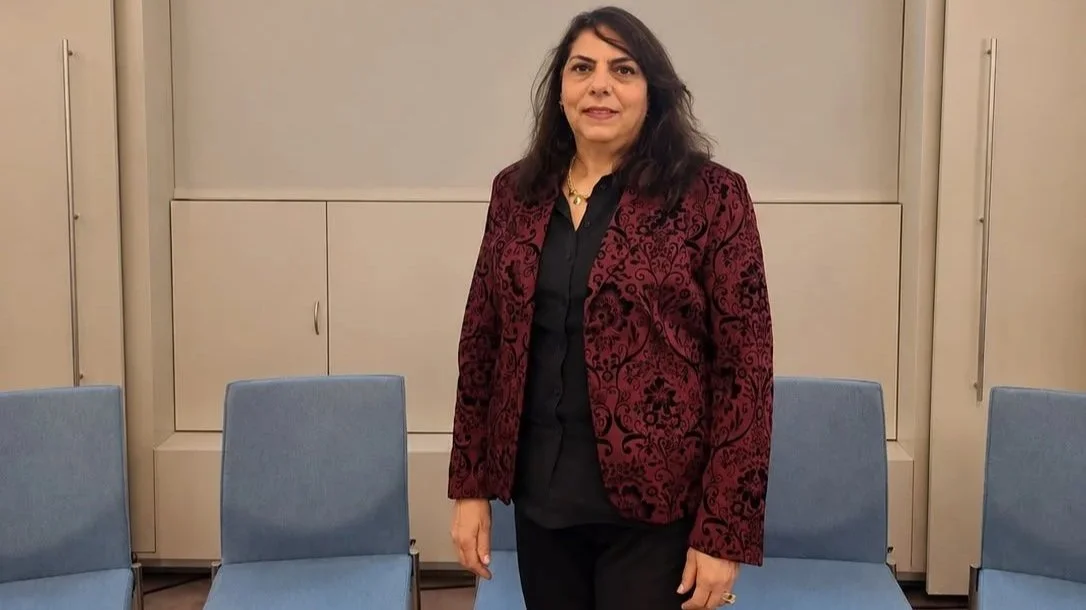
By Ms. Hana Kirreh
Freelance Consultant and Researcher and member of the ICC/DSPR/MECC Committee
Every year, from 25 November to 10 December, the world observes the 16 Days of Activism against Gender-Based Violence, reaffirming its commitment to ending violence against women and girls and protecting their fundamental human rights. The 2026 theme, “UNiTE to End Violence Against Women and Girls: Ensure Justice, Protect Survivors, End Impunity,”calls attention to a fundamental question: What does justice mean for women whose lives are shaped by multiple and intersecting forms of violence, insecurity, and discrimination?
Occupation is not gender-neutral. The consequences of prolonged occupation, armed conflict, and displacement affect women and men differently, often deepening existing gender inequalities. The UN Secretary-General’s Women, Peace and Security Report (2025) documents how the war in Gaza and the collapse of humanitarian infrastructure have disproportionately affected women. It highlights how funding cuts and conflict-related destruction have contributed to the closure or suspension of women-led organizations and essential protection services, including shelters, legal aid centres, and psychosocial support facilities.
These closures have far-reaching consequences. When essential services become unavailable, survivors of gender-based violence (GBV) lose access to protection, legal assistance, and psychosocial support, leaving them with fewer options to seek safety and justice. Meanwhile, the pressures associated with militarized daily life including checkpoints, military raids, displacement, movement restrictions, and economic insecurity can intensify household tensions and increase women's vulnerability to violence. At the same time, the weakening of institutions and the disruption of essential services undermine the capacity to prevent and respond to GBV. Feminist scholarship has long highlighted how conflict magnifies pre-existing gender inequalities; the Palestinian context illustrates how these inequalities become further entrenched under prolonged occupation and recurring violence.
For Palestinian women, these challenges cannot be understood in isolation from the wider political, social, and economic realities in which they live. The ongoing consequences of the war in Gaza, forced displacement, destruction of homes and infrastructure, restrictions on movement, settler violence, and the persistent effects of occupation across the occupied Palestinian territory create conditions that deepen women's insecurity and restrict their access to healthcare, protection, livelihoods, and justice. At the same time, patriarchal norms, gender discrimination, and gaps in institutional and legal protection create additional barriers for women seeking safety, support, and accountability. These intersecting forms of oppression do not affect all Palestinian women equally. Their experiences vary according to geographical location, age, disability, socioeconomic circumstances, and family situation, among other factors.
Observing the 16 Days of Activism in Palestine therefore requires more than condemning violence or reiterating international commitments. It requires examining whose suffering is recognized, whose rights are protected, which forms of violence receive attention, and whether justice is genuinely accessible to every woman and girl. It also requires listening to Palestinian women's voices, recognizing their lived experiences, and acknowledging their agency as human rights defenders, community leaders, and peacebuilders. Ultimately, the question is not simply how to end violence against women, but how to create the conditions in which every Palestinian woman can live with dignity, safety, freedom, and equal access to justice.
The multiple burdens facing Palestinian women occupation, patriarchy, economic precarity, and institutional erosion are interconnected and mutually reinforcing. Addressing one without confronting the others is insufficient. A comprehensive, rights-based approach requires sustained and flexible funding for Palestinian women-led organizations, protection of civic space and feminist activism, legal and institutional reforms to address GBV and ensure survivor-centred justice and services, strengthened international accountability for violations of women's rights, and political solutions that end the occupation, uphold Palestinian self-determination, and enable Palestinian institutions to function independently and effectively.
Palestinian women are not passive victims of violence and conflict; they are active agents of change, resilience, and peacebuilding. They continue to defend their rights, support their communities, and challenge the structures that perpetuate inequality and violence. However, their ability to protect themselves and others cannot rest on resilience alone. It requires functioning institutions, accessible justice, sustained international support, and an environment in which their fundamental rights are respected and protected.
Justice for Palestinian women means more than protection from individual acts of violence. It means addressing the political, social, economic, and institutional structures that perpetuate their vulnerability, ensuring accountability for violations, and guaranteeing their right to live freely, safely, and with dignity.