
Commemoration of the Entry of the Holy Family Into Egypt
From the Coptic Orthodox Church to the Whole World
Do You Know What Path the Family Took?
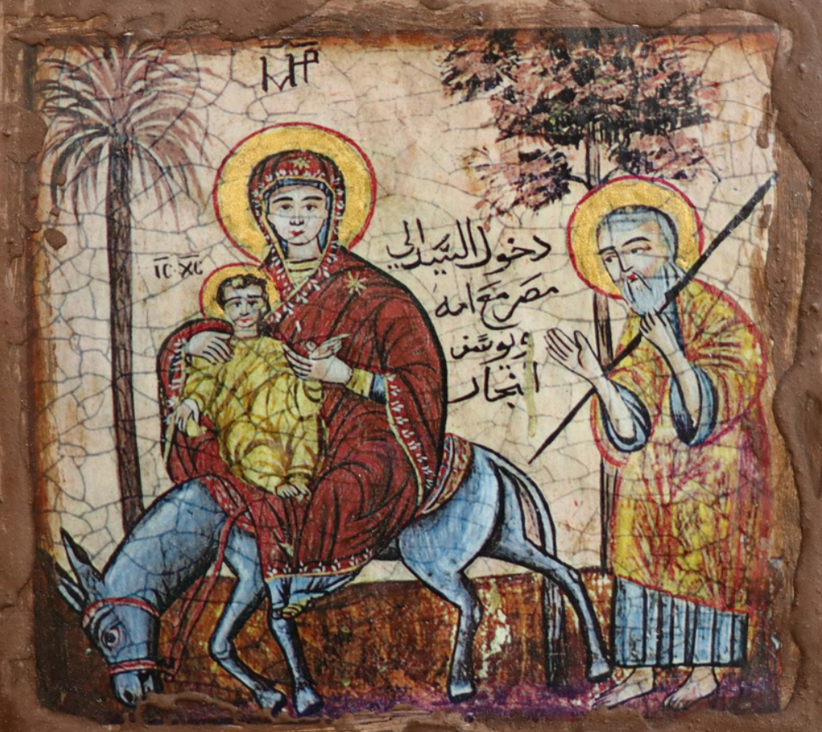
On Commemoration of the Entry of the Holy Family Into Egypt (June 1), we republish this article, which was previously prepared by the Media of the Middle East Council of Churches (MECC).
MECC Media
"Behold, the angel of the Lord appeared to Joseph in a dream and said, “Rise, take the child and his mother, flee to Egypt, and stay there until I tell you..." (Matthew 2:13). With this verse, Matthew the Evangelist revealed in the second Chapter the Holy Family’s refuge to the land of Egypt, an escape to this country holding a historic, geographic and cultural importance, according to His Holiness Pope of Alexandria and Patriarch of the See of Mark Tawadros II. But why fleeing? What is the path the family has taken?
Matthew the Evangelist mentions the reason for Jesus’ fleet to Egypt in the same chapter and the same verse, when he said, “Herod is going to search for the child to destroy him” (Matthew 2:13). This boy, who almost suffered the same fate as the rest of the children of Bethlehem whom King Herod ordered to kill after failing to find Him through the Magi, for “having been warned in a dream not to return to Herod, they departed for their country by another way.” (Matthew 2:12)
Joseph obeyed the angel and took his family to escape from Herod's tyranny, despite the hardships and dangers of travel at that time. Since the early centuries AD, the entry of the Holy Family to this country became a celebration of the Coptic Orthodox Church with the Fraihi rite on the 24th of the month of Bashans of the Egyptian calendar or the first of June of each year.
Back to the Egypt journey, it should be noted that it took them three and a half years where the Holy Family had to make several stops, all three of them: Jesus who was two years old at the time, His mother the Virgin Mary and Saint Joseph.
The most prominent of the stops the Holy Family made in Egypt were revealed for the first time in the manuscript of "Al-Mimar," a Syriac word meaning "biography" prepared by the 23rd Patriarch in the Chair of the Saint Mark Episcopate in Egypt between 385 and 412 AD. This memorial is found in three Arabic manuscripts, the first in the Vatican Library, the second in the National Library in Paris - France and the third in the Monastery of the Virgin of Muharraq in Egypt. This journey was also monitored in another memorial prepared by the Bishop of Sakha Qadas Anba Zakharias and the Bishop of Bahnasa, Holy Anba Kyriakos.
According to references, the journey of the Holy Family began in "Sinai", reaching "Al-Farma", heading to the village of "Tal Basta" located near Zagazig. “Basta” is hieroglyphic for ”Bastot” which means the house of God where the Holy family drank from the well and blessed the water to cure the ill. Then they went to “Belbeis” where Mary rested under a tree, then they traveled to “Minia Jinnah” or “Minya Samanoud” where they sailed to "Samanoud" and then to "Burullus".
After that, the Holy Family headed to "Sakha Issus", meaning "Sakha" in Kafr El-Sheikh Governorate, northern Egypt, where it is said in tradition that the foot of the man of Jesus Christ was imprinted there on a stone; Hence, the area was known as “Sakha Issus,” meaning “the heel of Jesus” in the Coptic language. Then it moved west to "Wadi El Natroun", where a monastic assembly center was established bearing the name "Bariat Shehit". From her to "Ain Shams" or "On" known as "Heliopolis", where the family bathed from the spring of Maa, which subsequently became blessed and sacred. Near the eye, a balm tree grew, which was made from the holy chrism oil to consecrate the churches and their utensils.
According to sources, the Holy Family continued its way and lived for a while in ancient Egypt in a cave that has become today “the Church of Abu Sarjah”, to move to “Maadi” and from there south to “Al-Bahnasa” or “Beni Suef” today, and then to Minya Governorate. They crossed the Nile River to the eastern bank where the Mountain of the Palm in which the palm of the Messiah was imprinted is located in the village of Deir al-Virgin in "Samalut", and from there to the Ashmonites in the city of Mallawi.
The Holy Family spent 6 months in Assiut, one of the longest periods they spent in an Egyptian region. This is where the Monastery of Our Lady, known as Muharraq, is located.
After the death of King Herod, the Holy Family returned to Palestine after the angel of the Lord appeared to Joseph again in his dream, and said: “Rise, take the child and his mother and go to the land of Israel, for those who sought the child’s life are dead.” With that, the Old Testament prophecy was fulfilled: “Out of Egypt, I called my son” (Hosea 11:1).
The Coptic Orthodox Church has designated an international Coptic day linking the Egyptian Copts in the diaspora, mentioned by His Holiness Pope Tawadros II in a speech he gave on the occasion of the commemoration of the entry of the Holy Family to Egypt in 2020, saying: “This visit blessed Egypt and this celebration was the Church of Egypt’s ritual until Copts began emigrating out of Egypt, and the presence of Copts in more than a hundred countries around the world made the first day of June an Egyptian celebration for both Copts and Egyptians day in the whole world under the name of the International Coptic Day.
If we go back in memory to previous dates, it is worth mentioning that in 2018 the path was included in the list of official Vatican visits. In June of the same year, the first official pilgrimage delegation from the Vatican headed to Egypt. The delegation included 52 people and their visit lasted 5 days after Egypt had received unofficial Christian pilgrims from India and the Philippines.
With the entry of the Holy Family into the land of Egypt, all of Egypt was blessed by them. For the occasion, many Holy Masses and various celebrations are held annually to commemorate this holy memory.