
Sermon of Reverend Dr. Paul Haidostian at the UAECNE Celebration for the 180th Anniversary of the Armenian Evangelical Church’s Founding
“With Freedom of Conscience and Sincere Faith”
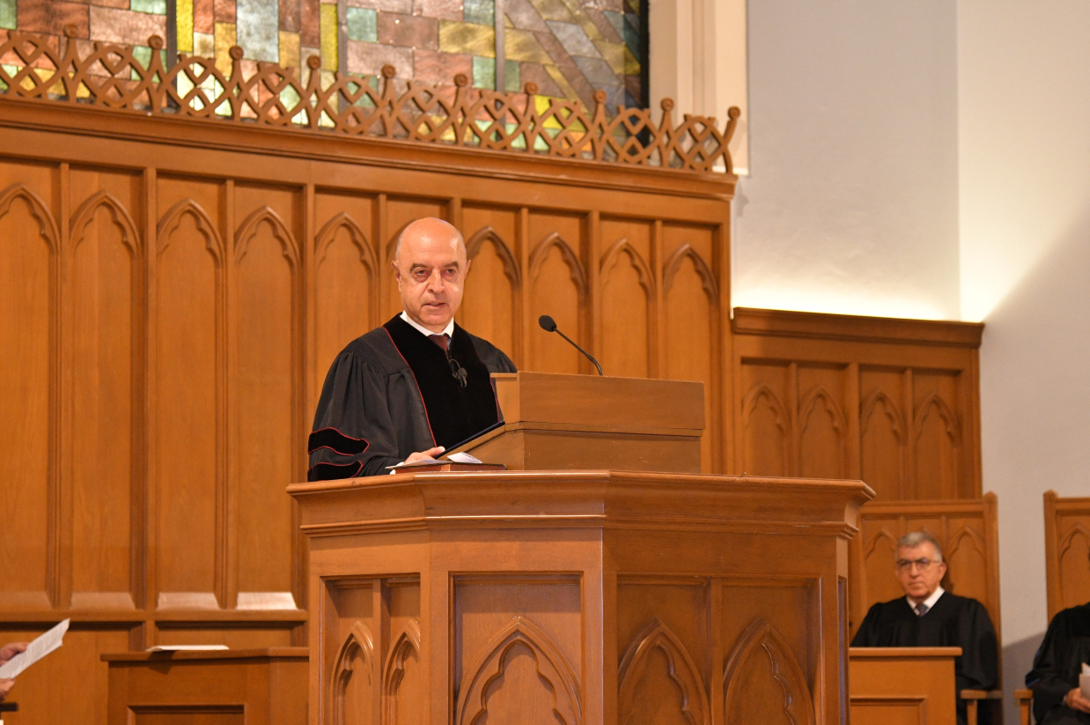
Below you can find the Sermon of Reverend Dr. Paul Haidostian, Acting President of the Union of the Armenian Evangelical Churches in the Near East (UAECNE), President of Haigazian University in Lebanon, and President of the Middle East Council of Churches (MECC) for the Evangelical Family, entitled “With Freedom of Conscience and Sincere Faith”, at the UAECNE Celebration for the 180th Anniversary of the Armenian Evangelical Church’s Founding, and the official opening of the UAECNE’s 79th annual General Assembly. The celebration was held on Sunday, June 21, 2026, at the First Armenian Evangelical Church in Beirut.
UAECNE SERMON
Reverend Dr. Paul Haidostian
“With Freedom of Conscience and Sincere Faith”
The Apostle Paul contrasts slavery and freedom. Slavery, which is sometimes described as servitude or bondage, is also a central theme in Galatians chapters 4–5.
When the obligation of the Old Testament Law, or any law, is used as the primary means of justification before God and humanity, it becomes a heavy yoke that keeps people in both inward and outward bondage. This was the issue surrounding circumcision that troubled the earliest Christians. What constituted Christian sufficiency: the written law, or something more?
The Apostle’s teaching was clear: if religion presents itself merely as a set of obligations defined by law, or as submission to forms and rituals, then faith is emptied of its spirit. Belief is reduced to a list of things to be performed.
In Christ, believers are no longer children under guardians and trustees, but sons and daughters of God through sincere faith in Christ (Gal. 4:1–7). This is why Apostle Paul declares, “Christ has set us free” (Gal. 5:1). This freedom is first and foremost liberation from the condemnation of sin, from the compulsion to earn salvation through good works, and from every human effort to seek righteousness apart from the grace of God.
Upon this foundation evangelical theology has emphasized the freedom of the Christian conscience.
Because salvation comes through faith in Christ and not through human regulations, mere traditions, or ecclesiastical requirements, the Christian conscience is ultimately subject to the Word of God and the lordship of Christ, rather than to the approval of temporary human authorities.
This freedom, however, is not an unrestricted self-directed life. Paul immediately warns: “Do not use your freedom as an opportunity for the flesh, but through love serve one another” (Gal. 5:13). Christian freedom is therefore responsible freedom. The believer’s conscience is free insofar as it is liberated from self-righteousness, shaped by God’s Word, guided by the Holy Spirit, and lived sincerely within the family of faith, the Body of Christ. Freedom is not the right to do whatever one pleases; it is the invitation to live faithfully before God and lovingly toward one’s neighbor.
In the mission of the Church, this means that the Church is called to be a community where people are not burdened by legalism, fear of authorities, or the illusion of external formalities. At the same time, the Church is not merely a collection of individuals in which everyone defines his or her own personal or relative truth. It is the fellowship of believers whose conscience is accountable to the Lord Jesus, whose lives are shaped by the Holy Spirit, and whose freedom is expressed through mutual service and love.
For 180 years, one part of the Body of Christ, the Church, has been known as Armenian Evangelicalism.
There is extensive documentation regarding its origins: how, in Constantinople during the 1820s, a pietistic and intellectual movement developed into a serious theological approach and a new academy; how Armenian clergy and laypeople formed Bible study and discussion groups in their homes; how the spiritual awakenings of the Western world and developments in biblical translation and publishing opened new horizons; how the influence of missionaries and reform-minded Armenians led to dissent, especially through a critical posture toward the Patriarchate of the day; and how these reformers endured years of persecution and excommunication because of this new Christian way of thinking.
The result was that on July 1, 1846, forty men and women, inspired by faith, gathered together in worship and prayer and formally named their ecclesiastical movement the Armenian Evangelical Church. At the same time, they declared that they had no ambition to create a new denomination nor any desire to imitate other church groups. Therefore, as an independent congregation, they elected their first pastor, Rev. Apisoghom Utudjian.
For many reasons, including educational, publishing, translation, medical, cultural, evangelistic, and devotional efforts, supported by Western missionary assistance but above all fueled by the fire of personal repentance and the personal testimony of salvation, the torch of reform spread rapidly among Armenians. Erzurum, Aintab, Aleppo, Kilis, Izmir, Kessab, Caesarea, Marash, Adana, Shushi, and many other Armenian centers became part of this movement. Within ten years, twenty-four churches had been established. Before the years of the Genocide, there were 137 churches, more than 180 pastors, hundreds of educational institutions, numerous periodicals and publications, and over 50,000 registered members.
It was a remarkable picture. Yet it was soon followed by the catastrophic destruction of our people, homeland, mission, innocent lives, and an entire emerging ecclesiastical system.
The past may seem distant, measured in hours and years, but we should not be naïve. Our renewed church life today has also been strengthened through the experience of past evil, by the mercy we received from God, especially through the hope of the resurrection, and through a critical self-examination. Let us pause here.
Worship is not the place to recount in detail 180 years of heritage and Armenian and spiritual contributions, nor to dwell on dark days, displacements, dispersion, and revival up to the present, as though we were merely presenting the history or evaluating the achievements of an organization or secular institution.
Beloved, the real question is this: To what extent is the Church the Body of Christ, and to what extent does it remain so? To what extent can it become alienated from that identity? This Armenian Evangelical question for valid for every church, every believer, and every servant of God. To what extent does the Church, in its essence, ministry, and expression, represent the grace of Christ’s Body in its own time, and to what extent does it fall into the trap of merely preserving its existence?
Therefore, let us return to one of the fundamental Evangelical distinctives clearly recorded in the declaration of the original Forty:
Freedom of Conscience.
“We respect ecclesiastical authorities. We reverently accept the ancestral traditions sanctified by the blood of martyrs. We love the Armenian Nation with all our heart and soul. Yet we regard freedom of conscience as more precious than all these things, and we will not allow any authority, tradition, or command to take from our hands the Gospel of Christ, nor to prevent us or our children, when we come without mediator or intercessor, from offering our spiritual worship to the Savior God according to our conscience.”
Statement of the Forty Who Founded the First Armenian Evangelical Church, Pera, Constantinople, 1846
The distinguishing emphasis in all of this is the stress placed upon freedom of conscience.
Freedom of conscience has several important Christian dimensions, some of which relate directly to this ecclesiastical celebration.
Freedom from Legalism
The Christian is called to live by faith working through love, yes, within an ordered life and constitutional structures, but not out of fear of regulations.
For example, a church member serves, gives, worships, and prays not in order to earn God’s favor, but because he or she has already received God’s saving grace.
Freedom from Coercion
True faith cannot be forced.
The Church, every church, persuades, teaches, testifies, serves, proclaims the Gospel, and cultivates discipleship, but it does not compel belief.
For example, the Church receives the sincere questions and doubts of its members rather than demanding submission according to worldly logic, even if the coercion comes from the Church itself, as was the case in Constantinople.
Freedom for Prophetic Witness
A free conscience enables the Church to speak the truth without restraint before all forms of authority, at the appropriate time, with the authority of the Gospel and in a Christlike spirit, examining our existence, our history, our calling, and the limitless horizons God has opened before us.
Throughout history, Christians have opposed unjust powers, discrimination, persecution, and oppression because their conscience belonged first and foremost to Christ. The Church must apply the same standard to itself, measuring its condition against the stature of Christ.
Here, opening a brief parenthesis, we may also ask: With the rapid advances of modern Artificial Intelligence (AI), how will the cultivation of freedom of conscience be affected? Or, perhaps, will humanity gradually surrender to a machine-generated version of conscience?
Freedom for Service and Love
Paul immediately joins freedom with love: “Through love serve one another” (Gal. 5:13).
Christian freedom of conscience is not self-centered independence but self-giving service. It is the deep conviction of the heart and the presence of God within the human soul.
For the Church Today
Perhaps one of the most urgent questions facing today’s Church concerns the nature and importance of the Christian conscience. In an age of political polarization, diluted convictions, ideological pressures, and cultural conformity, the Church must cultivate believers whose conscience is captive neither to worldly loyalties nor to fashionable trends—even when those trends wear spiritual clothing.
The conscience of both believer and Church must be grounded solely in the liberating Gospel of Jesus Christ. Such freedom forms mature disciples of Christ who can think, discern, love, bear witness, and serve faithfully God, their own people, and both neighbor and stranger alike. Such freedom cannot be taken away.
The free conscience derives its liberty not from human authority but from the Word of God, a conviction echoed by the Reformers. Yet this freedom is never isolation or separation. It is exercised within the family of faith, under the guidance of Holy Scripture, and in love toward others. This balance between freedom and responsibility, conscience and community, grace and discipleship remains one of Evangelical Christianity’s most enduring and valuable contributions to the contemporary Church.
The faithfulness of Christ’s Church, viewed through the Evangelical prism, must be translated into sincere commitment rooted in a Christ-shaped freedom of conscience.
If we are to seek any pride in these 180 years, let us examine ourselves in light of St. Paul’s illuminating words:
“For our boast is this, the testimony of our conscience, that we behaved in the world with simplicity and godly sincerity, not by earthly wisdom but by the grace of God” (2 Corinthians 1:12).
Let us view the past with humility. Let us receive our resurrected journey with gratitude for God’s mercy. Let us acknowledge with repentance our collective, personal, and institutional failures. Bowing before the Cross of Christ, let us move forward in the power of Christ’s resurrection.
The Church is the Body of Christ; we are merely fragile vessels. Let us stand before God with a free conscience, with simplicity, and with sincerity.
The world needs us, yes, in part. But even more, the world needs true life and eternal hope; therefore, it needs the salvation of Christ. We shall continue to proclaim His Gospel, beginning with the cultivation among us of freedom of conscience and committed faith.
Lord, forgive us. Strengthen us. May we celebrate our anniversaries in Your joy. May we always taste the unity of Christ’s Body. Glory be to You.
Amen.