
His Holiness Pope Leo XIV Issues Apostolic Letter 'In unitate fidei' on Nicaea Anniversary
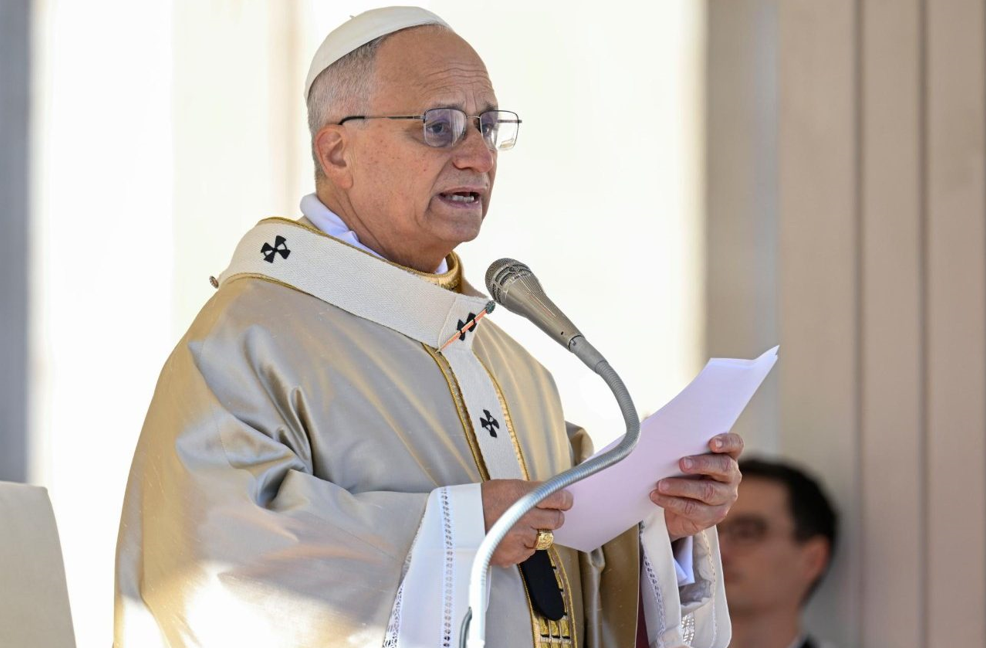
His Holiness Pope Leo XIV (@VATICAN MEDIA)
Ahead of his upcoming Apostolic Journey to Türkiye, His Holiness Pope Leo XIV issues the Apostolic Letter 'In unitate fidei' on the 1700th Anniversary of the Council of Nicaea, broken down into 12 points, with the hope of "encouraging the whole Church to renew her enthusiasm for the profession of faith."
By Deborah Castellano Lubov
Ahead of his upcoming Apostolic Journey to Türkiye, His Holiness Pope Leo XIV issued on Sunday, 23 November, the Solemnity of Christ the King, the Apostolic Letter 'In unitate fidei' on the 1700th Anniversary of the Council of Nicaea.
The full Letter, which has the hope of "encouraging the whole Church to renew her enthusiasm for the profession of faith," is broken down into twelve points, and can be read in its entirety HERE.
In 2025, the Catholic Church is commemorating the 1,700th anniversary of the First Council of Nicaea, convened in 325 AD by Emperor Constantine I in the city of Nicaea.
Hus Holiness Pope Leo XIV’s upcoming Journey to Türkiye will take him to Ankara, Istanbul, and İznik, once known as Nicaea, for the 1700th anniversary of the first Ecumenical Council.
The ecumenical council aimed to address theological disputes and establish a unified Christian doctrine, and its outcomes included affirming Christ's divinity and formulating the Nicene Creed.
With this in mind, Pope Leo's Letter, first and foremost, is a call to unity.
"In the unity of faith, proclaimed since the beginning of the Church," the Pope begins his text, "Christians have been called to walk in harmony, guarding and transmitting the gift they have received with love and joy," recalling, 'This is expressed in the words of the Creed, “I believe in one Lord Jesus Christ, the Only Begotten Son of God…for our salvation he came down from heaven.'"
The Pope remembered how this truth was so effectively formulated 1700 years ago by the Council of Nicaea, the first ecumenical gathering in the history of Christianity.
'The Creed gives us hope'
The Pope highlighted that ahead of his Apostolic Journey, he wished to draw the Church's attention to the profession of faith.
"For centuries," he said, "this enduring confession of faith has been the common heritage of Christians, and it deserves to be professed and understood in ever new and relevant ways. "
“For centuries, his enduring confession of faith has been the common heritage of Christians, and it deserves to be professed and understood in ever new and relevant ways”
In this Holy Year, dedicated to the theme of Christ our hope, the Pope called it "a providential coincidence" that we are also celebrating the 1700th anniversary of the First Ecumenical Council of Nicaea.
The Pope said the Council's proclamation in 325 A.D. of faith in Jesus Christ, Son of God, "is the heart of the Christian faith." "Even today, during every Sunday Eucharistic celebration," he acknowledged, "we recite the Nicene-Constantinopolitan Creed, the profession of faith that unites all Christians."
Moreover, "In these difficult times we are living, amid so many concerns and fears, threats of war and violence, natural disasters, grave injustices and imbalances, and the hunger and misery suffered by millions of our brothers and sisters," the Pope went on to observe, "this Creed gives us hope."
What unites us is greater than what divides us
Finally, the Council of Nicaea is relevant today because of its great ecumenical value. Indeed, the achievement of unity among all Christians was one of the main objectives of the last Council, the Second Vatican Council. Exactly thirty years ago, Saint John Paul II further promoted this conciliar message in his Encyclical Ut Unum Sint (25 May 1995).
Thanks to God, the ecumenical movement has achieved much in the last sixty years.
"It is true that full visible unity with the Orthodox and Eastern Orthodox Churches and with the ecclesial communities born of the Reformation has not yet been reached," the Pope acknowledged.
"Nevertheless, ecumenical dialogue, founded on one baptism and the Nicene-Constantinopolitan Creed," Pope Leo observed, "has led us to recognize the members of other Churches and ecclesial communities as our brothers and sisters in Jesus Christ, and to rediscover the one universal community of Christ’s disciples throughout the world."
Recalling that Christians "share the same faith in the one and only God, the Father of all people; we confess together the one Lord and true Son of God, Jesus Christ, and the one Holy Spirit, who inspires us and impels us towards full unity and the common witness to the Gospel," he highlighted, "Truly, what unites us is much greater than what divides us!"
"In a world that is divided and torn apart by many conflicts," Pope Leo reaffirmed, "the one universal Christian community can be a sign of peace and an instrument of reconciliation, playing a decisive role in the global commitment to peace."
“In a world that is divided and torn apart by many conflicts, the one universal Christian community can be a sign of peace and an instrument of reconciliation, playing a decisive role in the global commitment to peace.”
Pope Leo recalled that predecessor Pope, Saint John Paul II "reminded us, in particular, of the witness of the many Christian martyrs from all Churches and ecclesial communities," reiterating how "their memory unites us and spurs us on to be witnesses and peacemakers in the world."
Nicene Creed can be reference point in our Journey
The Pope underscored how critical it is to carry out this ministry credibly, and that this requires "walking together to reach unity and reconciliation among all Christians"…
This report was originally published on the Website of Vatican News. Please click here to read the full text.