
Cardinal Parolin: Holiness Pope Leo XIV a 'messenger of harmony, dialogue, peace in Middle East'
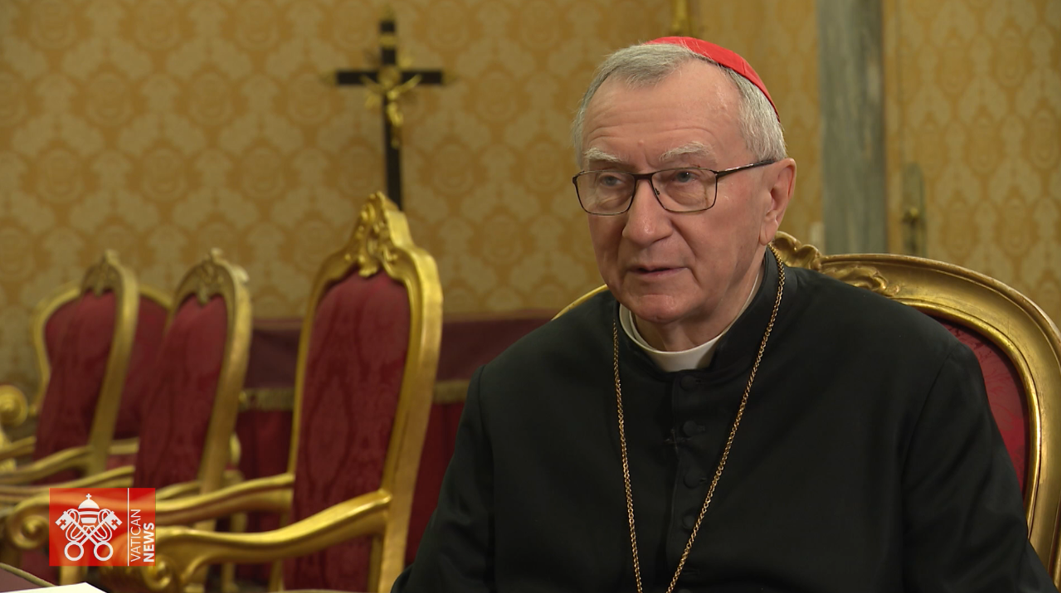
Cardinal Secretary of State Pietro Parolin
As His Holiness Pope Leo XIV prepares to visit Türkiye and Lebanon, Cardinal Secretary of State Pietro Parolin emphasizes the importance of the Apostolic Journey for ecumenical and interreligious dialogue, as well as his role as a sign of hope and peace.
By Massimiliano Menichetti
Türkiye and Lebanon stand ready to receive His Holiness Pope Leo XIV on his first international Apostolic Journey, which focuses on witness and encounter. The Pope is traveling to the Middle East to strengthen the faith and share the message of Christ.
In both countries, Catholic and other local communities in war-scarred regions are eagerly awaiting his visit. Despite their suffering, these nations have been able to build paths of dialogue, hospitality, and peace.
Two mottos have been chosen for the visit—“One Lord, one faith, one baptism” and “Blessed are the peacemakers”—highlighting the themes of hope, unity, and fraternity.
The visit to Türkiye will center on the Ecumenical celebration marking 1,700 years since the Council of Nicaea. In Lebanon, a special moment of the visit will be a silent prayer at the Beirut port, the site of the explosion five years ago that killed more than 200 people and injured 7,000.
Speaking to Vatican News in the following interview, Cardinal Pietro Parolin, Vatican Secretary of State, said the Pope’s visit will bring hope, peace, and renewed momentum for Christians in the Middle East.
Q: This is Pope Leo XIV’s first Apostolic journey. How is he preparing for his Pastoral visits to Türkiye and Lebanon?
The Pope takes up the pilgrim’s staff. Before him, there was Pope Paul VI, then Pope John Paul II, Pope Benedict XVI, and Pope Francis. In a sense, he follows in the footsteps of his predecessors. I imagine this will be a much-anticipated journey, being the first of his Pontificate.
He embarks with the sentiments that have always accompanied the Supreme Pontiffs in exercising their Petrine ministry: to meet the Christian communities in these lands and strengthen them in faith—which is the duty of the Successor of Peter—and at the same time to meet the peoples, their authorities, and civil communities, serving as a messenger of peace, harmony, and dialogue.
I imagine there will be joy, as well as a sense of responsibility in fulfilling the tasks entrusted to him.
Q: The 1,700th anniversary of the Council of Nicaea is central to the visit to Türkiye. What significance does this anniversary hold for the Church today, and what does the Pope’s presence symbolize?
It is a very important anniversary, and preparations have been underway for some time precisely to highlight its significance. The Pope’s presence itself emphasizes its importance.
The Council of Nicaea—1,700 years ago—laid the foundations of our faith: belief in Jesus Christ as fully divine and fully human. Christ is true God and true man. This is the foundation of all Christian faith, despite the many divisions that unfortunately still exist among us.
All Christians believe in Christ’s divinity and humanity; it is the cornerstone of our faith. Later, it is further developed by the Council of Constantinople, particularly regarding the Holy Spirit.
We should also note that this is a land that was a cradle of Christianity, where the first communities arose, to whom the apostolic letters—such as those of Saint Paul—were addressed, and where the first eight councils in Church history were held.
I would emphasize both the Christological focus, which lies at the heart of the Christian faith, and the ecumenical dimension, which brings us together to profess the same faith in Jesus, true God and true man.
Q: In Türkiye, the Pope will also visit the Blue Mosque. In a time so marked by fundamentalism, could this trip help strengthen fraternity and dialogue, and reaffirm that God’s name should never be invoked to kill or divide?
Yes, certainly. I was just recalling the Ecumenical dimension of the visit, which also includes interreligious dialogue. We recently celebrated the 60th anniversary of Nostra Aetate, which highlights not only the special bond between Christians and Jews but also what Christians and Muslims share.
I believe this is a gesture of dialogue, a sign of Interreligious respect, showing that Christians and Muslims can collaborate for a fairer, more supportive, and more fraternal world.
Recently, the Pope spoke at the Colosseum, saying that those who pray do not give in to fundamentalism. So this is both a rejection of fundamentalism and an invitation to strengthen collaboration for common causes.
Q: Lebanon is a country of integration that has rebuilt itself many times over the past 50 years. What message will the Pope bring to its people?
Above all, I think it’ll be a message of hope, because Lebanon needs hope. Recently, Lebanon has made some progress in resolving the crisis that has affected it in recent years.
Now, there is a president, a government, and reforms underway. But many difficulties, delays, and obstacles remain, which could slow or frustrate the population’s expectations.
The Pope’s message is one of encouragement: “Keep going, have courage, continue on the path you have begun.” At the same time, it expresses the Church’s closeness.
The Holy See has always been attentive to Lebanon precisely because—to quote an often-used phrase—‘it is a message more than a country,’ in the sense that peaceful coexistence has been achieved among the various religions and ethnic groups, and this must continue.
The Holy See has always stood close for this very reason, and will continue to do so. I believe the Pope’s presence is meant above all to convey this message.
Q: You mentioned earlier the many Papal journeys, following the first trips of Paul VI and 61 years after his first visit to the Holy Land during the Second Vatican Council. What is the significance of the Apostolic Journeys?
Papal journeys, beginning with Paul VI, have been seen as a modern instrument for exercising their ministry. They remain part of the mission entrusted by Jesus to Saint Peter: to strengthen the brethren and serve the unity of the Church.
Throughout history, there have been many ways to do this, but Popes have found that travel is a particularly suitable method.
In Pope Francis’ words, it represents the Church “going forth.” The Church does not wait for people to come to Rome but goes out to meet all peoples, cultures, and realities. Beyond the specific content of each trip, this is the global significance: the universal shepherd making the Church present to all…
This interview was originally publsihed on the Website of Vatican News. Please click here to read the full text.