
A Look at the Council of Nicaea's Impact on the Church
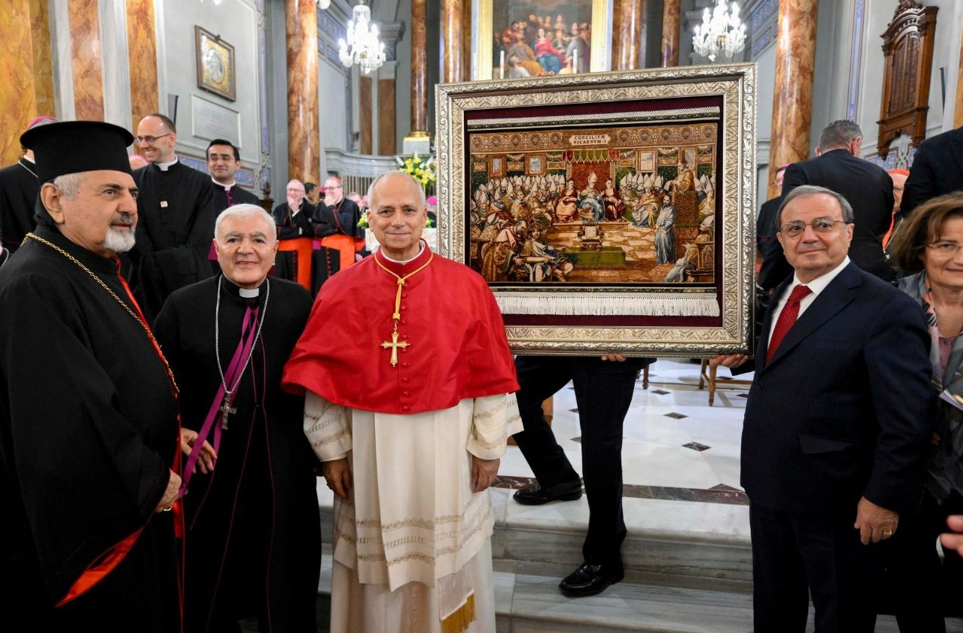
Holiness Pope Leo XIV poses for a photo with a reproduction of the Council of Nicaea during his visit to the Cathedral of the Holy Spirit in Istanbul on November 28, 2025 (@Vatican Media)
As His Holiness Pope Leo XIV visits the site of the Council of Nicaea, held in 325, we recall the importance of the first Ecumenical Council's proclamation of the Church’s faith in the divinity of Jesus Christ, which also established the date for Easter for all Christians.
By Christopher Wells - Istanbul
The first Ecumenical Council in the history of the Church took place in 325, in an era of epochal change. After some two hundred fifty years of persecution, the decision of the Emperor Constantine to legalize Christianity allowed Christians to worship in freedom throughout the Roman Empire.
But the freedom for the Church was not without controversy. In the early years of the fourth century, an Alexandrian priest, Arius, provoked a firestorm when he challenged the true divinity of Jesus Christ. For Arius, Jesus was not fully God, but merely a creature—albeit a creature exalted to a position next to God the Father and above all others—and “there was a time when He was not.”
The doctrinal controversy soon swept throughout Christianity, threatening to divide the Church. In response, Constantine called together a universal synod, inviting all the bishops throughout the world.
Most were from the Greek-speaking east, but the Latin-speaking west was represented by several bishops, as well as the legates of Pope Sylvester, and there were several bishops from beyond the confines of the Roman Empire.
They gathered in the city of Nicaea, not far from the new imperial capital of Constantinople (modern-day Istanbul), to determine definitively the faith of the Church.
After heated discussions, the bishops—traditionally numbering 318—composed a Symbol or Creed, a written statement of the Christian faith.
The teachings of Arius were definitively rejected with the formula, “[We believe] in one Lord Jesus Christ, the Son of God, begotten of the Father [the only-begotten; that is, of the essence of the Father, God of God,] Light of Light, very God of very God, begotten, not made, consubstantial [Greek: homousious, ‘of the same substance’] with the Father.”
Today, the Council of Nicaea is recognized as authoritative by all Christian Churches and communities, and the Creed proclaimed by the Council, with later additions by the Council of Constantinople, is recited by Christians around the world.
The date of Easter
While the question of Jesus’ divinity was the primary occasion for the Council, the Fathers of Nicaea were also concerned with issues affecting the whole Church, notably the question of the date of Easter.
The Council’s decision provided the means of calculating the celebration of the Lord’s reconciliation, though subsequent disagreements have led to different means of applying the formula determined by the Nicene Bishops.
Nonetheless, the ecclesial unity that marked the Council of Nicaea stands as a witness to and inspiration for the ecumenical journey Christians are making today.
This text was originally publsihed on the Website of Vatican News.