
Sermon of His Eminence Archbishop Hosam Naoum at the Anglican-Lutheran Annual Simulcast Lessons and Carols Service
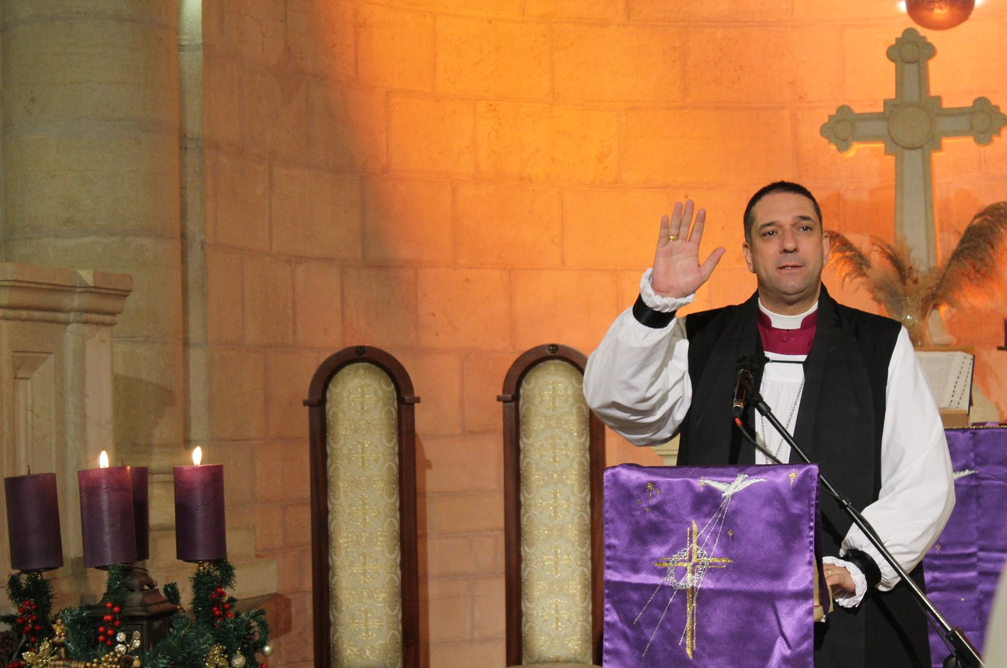
The Anglican-Lutheran Annual Simulcast Lessons and Carols Service was held, in the presence of His Eminence Archbishop Hosam Naoum, Anglican Archbishop in Jerusalem, the Head of the Church for the Episcopal Diocese of Jerusalem, and Member of the Executive Committee of the Middle East Council of Churches (MECC), on Saturday 13 December 2025, at the Bethlehem Lutheran Church and the Episcopal Cathedral in Philadelphia.
You can find in the following His Grace Archbishop Hosam Naoum’ Sermon:
My Dear Sisters and Brothers: Greetings in the name of our Lord Jesus Christ, the Prince of Peace and the King of Love.
Let me first of all offer Advent greetings to those present here in Bethlehem at this beautiful service in the Lutheran Christmas Church.
My warm wishes go especially to our dear fellow Servant of Christ, Bishop Azar, who is for the final time hosting us here with Pastor Ashraf and his other clergy. We will miss you in this ministry, Sayidna, even as we look forward to welcoming your successor, Bishop-elect Imad Haddad, at his consecration next month.
I also welcome our friends around the world viewing online, and in particular to those sharing this service in Philadelphia.
I am especially grateful to Bishop Daniel Gutierrez and his clergy for arranging for this simulcast to once more be held in the Cathedral in Philadelphia. This joint service marks a small but important part of our companion relationship with the Diocese of Pennsylvania.
A special thanks also to Bishop Penman, Bishop Curry, and to all our Lutheran partners in America. Thank you for standing in solidarity with us Christians here in the Land of the Holy One.
With all of you, we rejoice to join together in this service as we look forward to our celebration of Christ’s birth on Christmas Eve, just ten days from now.
In my homily this evening, I would like to explore the theme of “The Incarnation as Love.”
Here, I do not mean love in a sentimental manner. I mean love as God’s supreme act of compassion on behalf of his fallen creation. For our Heavenly Father could not bear to see his loving creation destroyed by its sinfulness.
As St. Athanasius writes, “For we were the purpose of his embodiment, and for our salvation he so loved human beings as to come to be, and appear in a human body” (The Incarnation of the Word 4).
Because of His great love for us, “God did not wish to remain distant or to heal the wounds of the world from a distant heaven. He desired to enter our world, to take on our nature, to walk our roads, to feel our pain, and to draw near to us so that we might know that love is not an idea but a person—not merely a promise, but a presence” (Hosam Naoum, Daily Advent Booklet, 2025).
Yet God did not only come to be present with us in the Incarnation and birth of our Lord Jesus Christ. He came also to save, redeem, and transform us, “so that we might become children within His love” (ibid).
In the Nativity, Christ was born in humble and difficult circumstances. Human sin and human suffering were present all around him. And yet, as the angel announced to the shepherds, his birth was a sign of hope:
“For behold,” said the angel, “I bring you good news of a great joy that will be for all the people. For unto you is born this day in the city of David a Savior, who is Christ the Lord.”
It is with the shepherds that we kneel before the manger and behold God’s gracious gift of love. There, we set before the Christ-child all our sins, our sorrows, all our inner wounds and pain. In turn, we receive hearts warmed by God’s forgiveness, mercy, and grace. That grace in turn empowers us to pass along a measure of the great love we have received.
Two years ago, in this very church, the notion was conceived that Christ was born not only in a cave in Bethlehem, but in the midst of the rubble of our own times: That our Savior was born in the rubble of Gaza . . . the rubble of the West Bank . . . the rubble of anywhere in the world where the sting of suffering and death continues to afflict God’s children.
And indeed, the love of God in Christ’s Incarnation transcends the boundaries of time and space. For this love is present not only through His Spirit, but in the midst of his gathered people, the transformed Body of Christ.
After visiting the many afflicted in Gaza this past summer, Cardinal Pierbattista made this connection clear. “Christ is not absent from Gaza,” he said. “He is there—crucified in the wounded, buried under rubble, and yet present in every act of mercy, every candle in the darkness, every hand extended to the suffering.”
His Beatitude, Patriarch Theophilos III echoed those words, stating, “the Church’s mission in times of devastation is rooted in the ministry of presence, of standing with those who mourn, of defending the sacredness of life, and of witnessing to the light that no darkness can extinguish.”
Within our joint Anglican-Lutheran ministry, this light manifests itself most brightly in the partnership between our al-Ahli Arab Hospital, the Lutheran World Federation, and Augusta Victoria Hospital.
For more than two years, our staffs have labored together in the midst of great hardship, extending the loving hand of Christ to those needing rescue from the rubble…
This Sermon was originally published on the Facebook Page of His Eminence Archbishop Hosam Naoum, Anglican Archbishop in Jerusalem. Please click here to read the full text.