
The Epitaph Service at the Greek Patriarchate of Jerusalem
From the General Secretariat of the Greek Patriarchate of Jerusalem
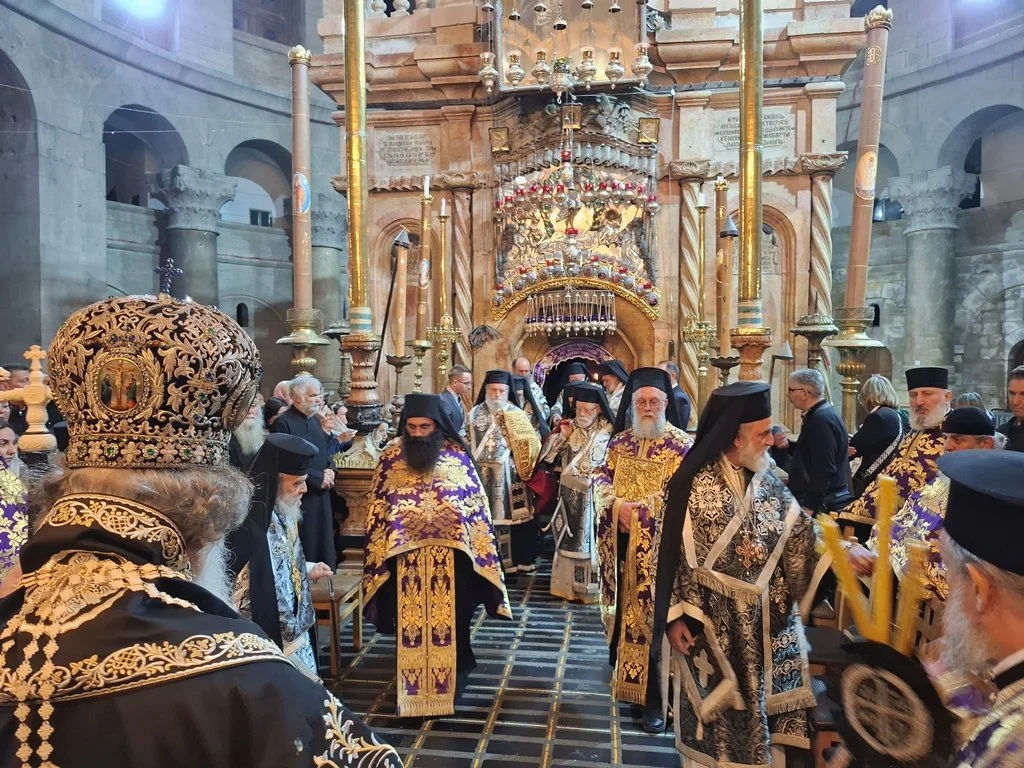
At 11:00 p.m. on Holy Friday, 5th/18th April 2025, the Epitaph Service—the Divine Burial of our Lord and God and Saviour Jesus Christ—was held at the Church of the Holy Sepulchre.
For this service, the Brotherhood of the Holy Sepulchre, accompanied by His Eminence Metropolitan Makarios of Ainea of the Ecumenical Patriarchate, who was their guest, and led by His Beatitude Patriarch Theophilos III, Greek Orthodox Patriarch of Jerusalem and honorary President of the Middel East Council of Churches, proceeded to the Church of the Holy Sepulchre as the bells tolled mournfully. They passed through the Deposition from the Cross and the Holy Sepulchre and entered the Catholicon.
There, the Canon of Great Saturday was chanted until the Patriarch instructed the priests to vest, and the Hierarchs and Priests put on their liturgical garments.
Once vested, the procession exited the Catholicon, turned right towards the Franciscan Shrine “Touch Me Not”, where a supplication with exclamation was offered. The procession then moved through the Holy Shrines—those of the Nails, Saint Longinus, “They divided My garments among them”, the Crown of Thorns, and Adam’s Chapel—and ascended to the Sacred Golgotha.
There, the Gospel of the Crucifixion of Christ was read, a supplication was offered, and veneration was made by the Patriarch, the Hierarchs, the Consul General of Greece in Jerusalem, Mr Dimitrios Angelosopoulos, and the Consul, Mr Petros Anagnostaras. Then, four Hierarchs lifted the silk corporal bearing the Body of the Lord, which had been reverently prepared on the Holy Altar of Sacred Golgotha, and descended, placing it on the Stone of the Holy Deposition.
At that moment, His Beatitude read the corresponding Gospel passage concerning the Deposition from the Cross and the Burial of the Lord by Joseph of Arimathea and Nicodemus, the secret disciple of the Lord.
Following this, the procession continued around the Holy Sepulchre three times, with the chanting of the chief cantor of the Church of the Resurrection, Deacon Eustathios, and those assisting him.
After the procession, the chanting of the Lamentations began, led by His Beatitude, the Hierarchs, the chanters, and the congregation in three Stases. At the end of the three Stases and before the Exaposteilaria, a sermon was delivered in Greek by the Elder Chief Secretary, His Eminence Archbishop Aristarchos of Constantine, as follows:
“Your Beatitude, Father and Master,
Revered Assembly of Hierarchs,
Your Excellency, Consul General of Greece,
Devout Priests,
Pious Pilgrims,
Today, at the close of Holy and Great Friday and on the threshold of Holy and Great Saturday, in this deeply moving and majestic service of the Epitaph, the Church experiences within herself, presents to her members, and proclaims to the whole world the mystery of the Cross and Burial of the Son and Word of God, our Lord Jesus Christ, looking toward His Resurrection.
Once again, the Church declares that which the Prophets foresaw and foretold through the Holy Spirit, and that which the eyewitnesses, the Disciples, the Apostles, and the Mystics of the Lord beheld with their eyes and handled with their hands.
For out of the utmost love for mankind, God the Father was well pleased, and His Only Begotten Son—”who is in the bosom of the Father, he hath declared him” (John 1:18)—took upon Himself, from the Holy Spirit and Mary the Virgin, human flesh endowed with reason and soul. “He was born secretly in a cave,” and He dwelt among men. All this came to pass not by a change in place, but by divine condescension, for as the hymnographer of the Akathist declares: “He was wholly among those below, yet in no wise absent from those above, the Uncircumscribable Word.” In His one Divine-Human hypostasis and in His two natures—divine and human—the Son and Word of God, being God Himself, blessed mankind in manifold ways.
He fulfilled the perfect law of love, not only toward one’s neighbour but even toward one’s enemies. He healed the incurable, raised the dead—among them His friend Lazarus of Bethany, whom He raised on the fourth day.
He, as the “Deliverer of our souls,” healing on the Sabbath, often taught the true liberty of man in contrast to the rigid observance of the Sabbath law, saying, “The sabbath was made for man, and not man for the sabbath” (Mark 2:27). This teaching became the chief false accusation and slander brought against Him, for which He was arrested by the rulers of the Jews and condemned to death—even the death of the Cross—by the Roman governor Pontius Pilate.
In obedience to the good pleasure and will of the Father, He willingly accepted the Cross on our behalf: “He is brought as a lamb to the slaughter, and as a sheep before her shearers is dumb, so he openeth not his mouth” (Isaiah 53:7). Of His own will, He shed His blood for the whole of humanity upon this Dread and Holy Place. With His Most Pure Blood, He signed the New Testament for all the peoples of the earth…
Click Here to Check All the Photos.
This news was originally published on the website of the Greek Orthodox Patriarchate of Jerusalem, click here to read more.