
His Holiness Pope Tawadros II Consecrates the Church of Saint Mina in Fleming, Alexandria
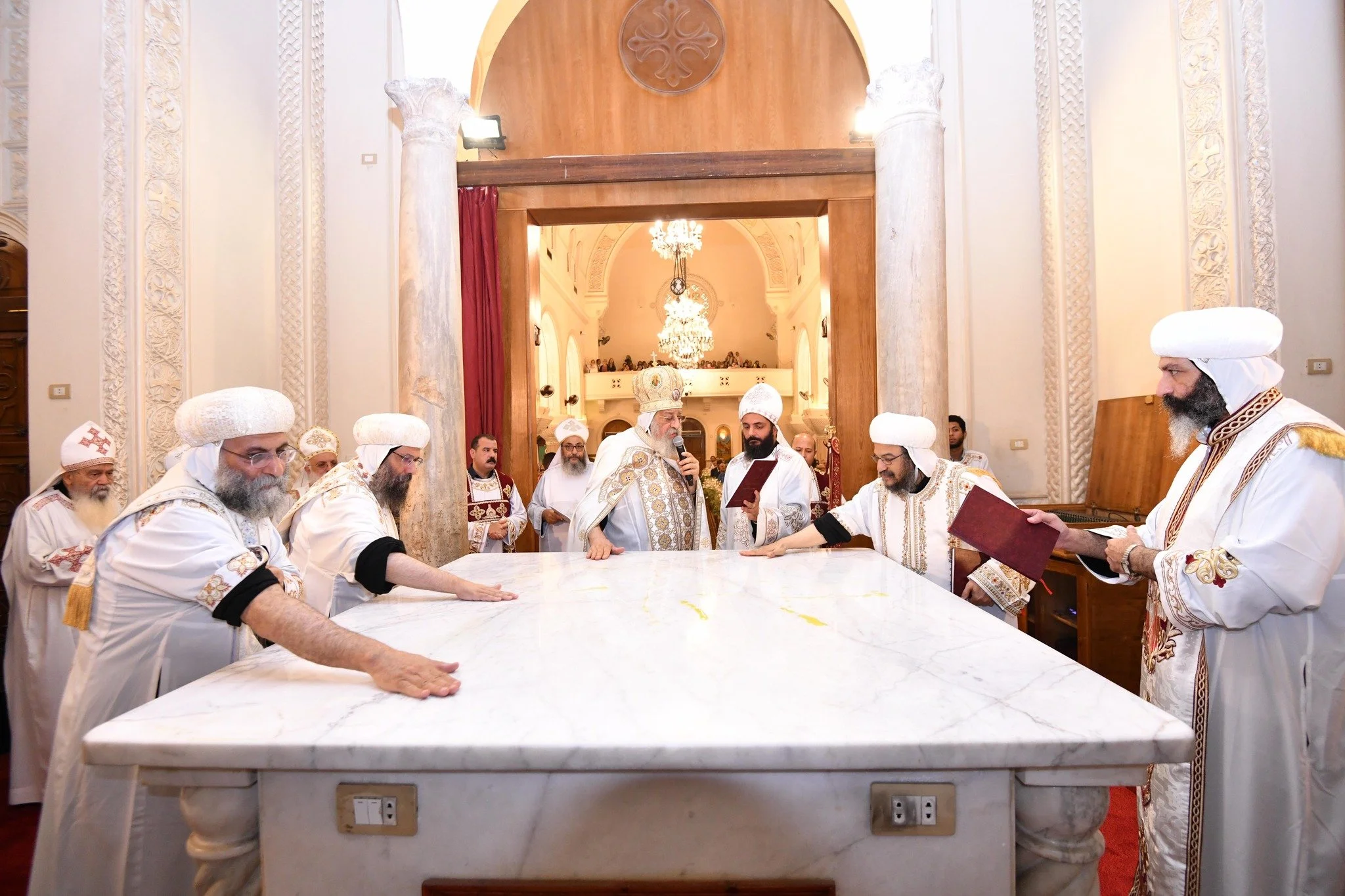
On Saturday, His Holiness Pope Tawadros II, Pope of Alexandria and Patriarch of the See of St. Mark consecrated the Church of Saint Mina in the Fleming district of Alexandria.
Upon his arrival, the clergy of the church received His Holiness with reverence, while children presented to him bouquets of flowers in a gesture of welcome. Pope Tawadros proceeded directly to the commemorative plaque marking the consecration of the church, which he blessed by making upon it the sign of the Cross. Photographs were then taken of His Holiness surrounded by the bishops, priests, and members of the church council.
Afterward, the procession of His Holiness entered the church, led by the choir of deacons chanting hymns of welcome for the patriarch. The congregation greeted Pope Tawadros as he walked through the central aisle, and he blessed them with the sign of the Cross.
The consecration prayers then commenced, with the participation of four bishops of the Church. Three altars were consecrated:
1. The main altar, in the name of Saint Mina.
2. The northern altar, in the name of the Archangel Michael.
3. The southern altar, in the name of Virgin Mary.
In addition, the icon of the Pantocrator above the eastern wall of each sanctuary was consecrated, along with the icons of the iconostasis and those placed within the nave of the church.
In his speech following the consecration, His Holiness reflected upon the meaning of its rites and expressed gratitude to the priests of the church, its council, the deacons, and the archons, remembering with honor the late Hegumen Antonious Saad, who had served the church and initiated its expansion and development.
Pope Tawadros and the bishops signed the consecration document, after which the Divine Liturgy began. In his sermon, His Holiness expressed his joy at consecrating the church, describing it as “a church of service ” that has ministered to the community of Alexandria for many decades. He noted that in the Coptic lectionary, the readings of the second half of the final month of the Coptic year (Mesra) often speak to us about the Kingdom of God. Drawing from the Gospel of the day, he posed the question: “Who among us will have a share in heaven?” and he identified five categories of people who shall inherit this blessed portion:
1. The Penitent: “The heart is like a closed treasury, hidden within the chest. None knows what is inside it except the person himself, and none sees it except God. According to what is in this heart, the destiny of man is determined. The monastic region in Wadi El-Natrun is called the Desert of Scetis, and the word Sheeheat means ‘the weighing of hearts,’ signifying that a person must weigh (examine) his heart to discern what is within it. Therefore, keep your heart in repentance.”
In monastic tradition, a novice is often tasked with the laborious work of purifying a sack of rice—an exercise requiring patience and endurance. Through this process, the monastic novice learns patience and the virtue of purifying the heart from impurities
2. The Loving: This refers to those who love Christ, for “the love of God has been poured out in our hearts by the Holy Spirit who was given to us” (Romans 5:5). The love of Christ is wondrous, for within us there is nothing that merits such love. As Saint John declares, “We love Him because He first loved us” (1 John 4:19). Whoever truly loves Christ loves all people without exception—regardless of gender, appearance, language, belief, or color—simply because they are God’s creation.
This love is manifested through many behaviors and deeds, such as works of mercy, acts of assistance, and other forms of kindness. "My little children, let us not love in word or in tongue, but in deed and in truth" (1 John 3:18). That is, we are called to love by genuine action.
These are the loving ones who extend love in their homes, in the church, in society, and in every place where they are found
In the world, promotion is viewed as an ascent, where one begins in a lowly position and gradually rises to higher ranks. In Christian thought, however, promotion is directed downward. This principle was established by our Lord Jesus Christ when He washed the feet of His disciples, teaching them an important lesson. Therefore, the highest degree of promotion is found in bowing down and washing the feet of others—with humility and genuine love.
3. The Worshippers in Praise: Those who live in a spirit of constant prayer and praise. The Coptic Church is distinguished by its richness in prayers and hymns that nourish the whole being. Prayer may be offered:
-In a single word: “Kyrie eleison” (Lord, have mercy).
-In a phrase: “Lord Jesus Christ, have mercy on me, a sinner.”
-In passages from the Agpeya prayers.
-Through music: hymns, praises, doxologies, and spiritual songs…
Click here to view the photos.
This News was originally published on the Facebook Page of the Coptic Orthodox Church, click here to read more.