
Speech of His Holiness Patriarch Mor Ignatius Aphrem II during his participation in the “Heart of Stockholm” event as part of the Ecumenical Week celebrations
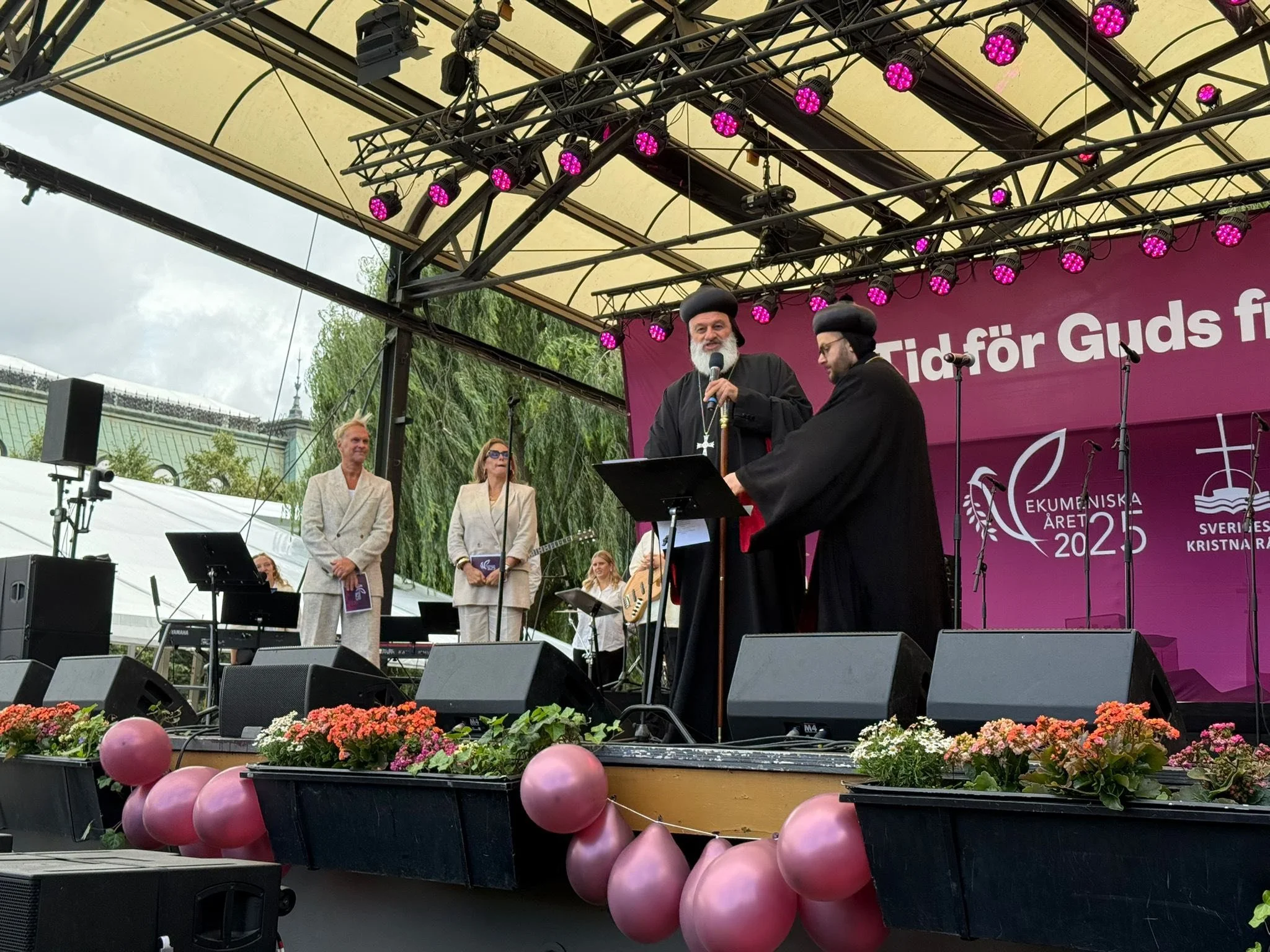
We publish below the full text of the speech delivered by His Holiness Patriarch Mor Ignatius Aphrem II, Patriarch of Antioch and All the East, Supreme Head of the Syriac Orthodox Church of the World, and Honorary President of the Middle East Council of Churches (MECC) during his participation in the “Heart of Stockholm” event as part of the Ecumenical Week celebrations
It is with great spiritual joy that I stand among you as we commemorate two great events which became milestones in the history of global christianity. Namely, the council of Nicea in 325 and the 1925 Stockholm Conference.
In Nicea, the bishops and teachers of the church arrived from different parts of the world carrying with them their physical wounds as a result of different persecutions by civil authorities and spiritual wounds resulting from heretical teachings and divisions challenging the faith and unity of the church. They were able to articulate in a profound way the faith of the church in the triune God and explain the mystery of the Incarnation of our Lord Jesus Christ. In reality they were seeking to restore peace and unity in the church.
In Stockholm, eminent church leaders and theologians came together at the invitation of the primate priest of the Church of Sweden, Archbishop Nathan Söderblom carrying with them the wounds of a fractured world trying to recover from the death and destruction caused by years of the First World War.
They emphasized the role of the church to heal the wounds of world and promote peace and reconciliation in the aftermath of the war.
The purpose of both meetings was to make peace which grants us the grace and privilege to be the children of God as the sermon on the mount teaches us.
In the Syriac tradition, Peace – Shlomo – is more than the absence of conflict. It is the fullness of life with God and with our neighbor. St. Aphrem the Syrian, in his Commentary on Tatian’s Diatessaron (Oxford, 1993, p. 325), teaches that peacemakers resemble the Creator because “they heal divisions and unite what is broken.” Thus, to be a peacemaker is to manifest the likeness of God, “For He Himself is our peace, who has made both one, and has broken down the middle wall of separation,”
Ephesians 2:14 and to live as His true children.
Making peace continuous to be the duty of the church, especially during these difficult times of wars, famines and pandemics. One of the most troubled regions of the world which is in dire need of peace is the Middle East where people have been suffering for many decades as a result of occupation, terrorism and oppression as is the case in the Holy Land.
Most recently my own homeland Syria has been facing tremendous challenges following the change of regime which took place in December of last year. Christians are the indigenous people of Syria, and lived with other Syrians in peace and harmony for centuries are very anxious about their existence. Many are leaving their country. They need to be assured that they can live with dignity and equal rights and obligations in a state which is built on the rule of law and respects all its citizens.
Peace, therefore, must be built on justice, respect, and reconciliation. It cannot be imposed from outside; it must grow from within – from hearts purified of hatred, and from communities willing to embrace one another again as brothers and sisters. This is why the call of Christ to be peacemakers is urgent. It is a call to every Christian and every person of goodwill to stand for truth, to defend the dignity of all.
As we gather today in Stokholm –Sweden to reflect on the urgent theme of “Time for God’s Peace”. Let us affirm that now is the time to work tirelessly for peace in our world “and the peace of God, which surpasses all understanding, will guard your hearts and minds through Christ Jesus.” Philippians 4:7
Amen.
Click here to see the Photo Album
This news was originally published on the Facebook Page of His Holiness Patriarch Mor Ignatius Aphrem II.