
"Stories of the Planted Tree" (Part 11) – Waiting and Faith, in the Wednesday Meeting of His Holiness Pope Tawadros II
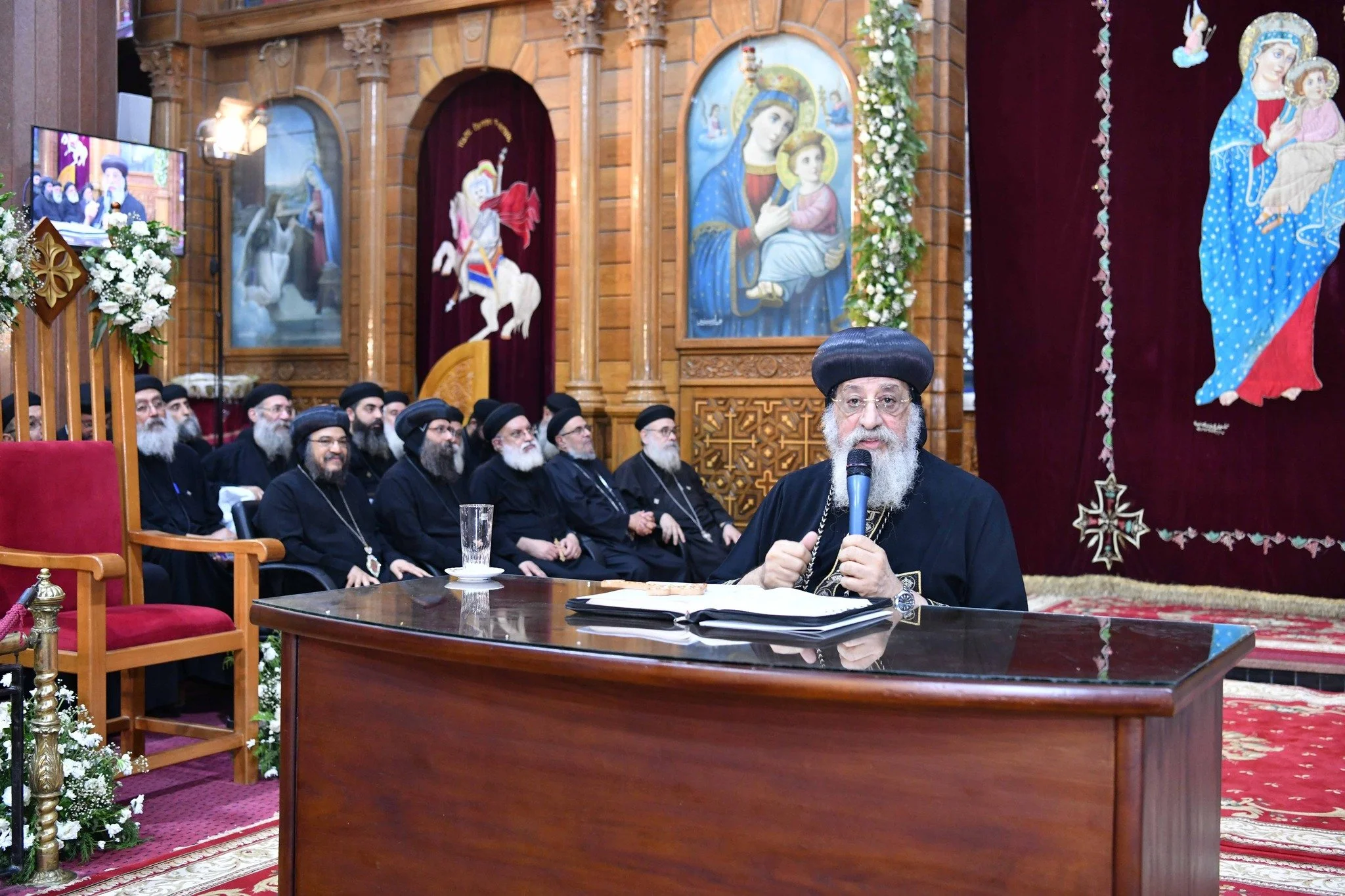
His Holiness Pope Tawadros II, Pope of Alexandria and Patriarch of the See of St. Mark, delivered his weekly Sermon in the Wednesday Meeting, at the Church of Virgin Mary and St. George in the Ghobrial district of Alexandria. The sermon was broadcast through Christian satellite channels and the online C.O.C. channel of the Church Media Center.
His Holiness prayed the Vespers Prayers, joined by Their Graces Bishop Pavly (General Bishop of the Montazah sector churches), and Bishop Hermina (General Bishop of the Eastern Alexandria sector churches), as well as Hegumen Abram Emil (General Deputy of the Patriarchate in Alexandria), the priests of the church, a number of Priests from Alexandria, the Deacons’ choir, and a great multitude of the congregation who filled the Church.
After the Vespers Prayers, Hegumen Reweis Morcos, the church’s priest and former General Deputy of the Patriarchate, welcomed His Holiness and shared the joy of his spiritual children. He spoke, from his long years of acquaintance with His Holiness, of three qualities that distinguish him: he is prayerful, abundantly cultured and enlightened in thought, and a lover of order and discipline.
In turn, Bishop Hermina expressed his joy at the visit of Pope Tawadros to the Ghobrial district, describing him as a preacher and bearer of glad tidings.
Before the sermon, His Holiness Pope Tawadros expressed his happiness in visiting the Ghobrial church, noting that he had visited it many times and that it holds a special place in his heart. He described its service as a blessed one, commending its priests, servants, deacons, and archons. He congratulated the congregation on the commemoration of the major feasts of the Lord (the 29th of the Coptic month) which falls tomorrow, as well as the coming Feast of Nayrouz and the beginning of a new Coptic year.
In his sermon, His Holiness continued the series "Stories of the Planted Tree" and spoke on the theme of “Waiting and Faith.” He referred to Matthew chapter 24 and Mark chapter 13, reading several verses from Matthew 24 (verses 11–14, 24, 34–35, 42–44), noting that both chapters speak about the Second Coming of Christ.
He also reflected on two statements from the Creed:
“And He shall come again in His glory to judge the living and the dead, whose kingdom shall have no end.”
“We look for the resurrection of the dead, and the life of the coming age.”
Pope Tawadros explained that in the First Coming, the Lord Christ was incarnate and emptied Himself, whereas in the Second Coming, He will come in glory to judge the living and the dead.
Pope Tawadros explained why we await the life of the age to come:
1. Christ is risen: Our life on earth ends, but we shall rise on the last day. Without His Resurrection, our faith would be in vain:
“But now Christ is risen from the dead, and has become the firstfruits of those who have fallen asleep” (1 Corinthians 15:20).
2. Death has become a passage into eternity: Life on earth is temporary:
“For here we have no continuing city, but we seek the one to come” (Hebrews 13:14).
3. God created us for eternity: The Lord has prepared for each of us a place in heaven:
“For God so loved the world that He gave His only begotten Son, that whoever believes in Him should not perish but have everlasting life” (John 3:16).
4. The Coming of the Judge: Christ will return to separate the righteous from the wicked and to honor the righteous:
“For we must all appear before the judgment seat of Christ, that each one may receive the things done in the body, according to what he has done, whether good or bad” (2 Corinthians 5:10).
His Holiness described how the Church (the planted tree) lives a life of waiting and faith:
1. “Greet one another with a holy kiss”: In every Divine Liturgy, the Church gives us an opportunity to reconcile with all through a holy and esteemed expression.
2. “You who are seated, stand”: This call signifies standing up from sin.
"Blessed is the man who walks not in the counsel of the ungodly, nor stands in the path of sinners" (Psalm 1:1).
Standing is a sign of readiness and waiting.
3. “Look toward the east”: The east is the source of light; churches are built facing east, from which Christ will come:
“For as the lightning comes from the east and flashes to the west, so also will the coming of the Son of Man be” (Matthew 24:27).
4. The Night of the Apocalypse (Abughalamsis): Prayers begin at night, symbolizing the world, and end at the rising of light. It is a miniature expression of “We look for the resurrection of the dead.” On this night, the Book of Revelation is read in full to prepare for eternity:
“I am the light of the world. He who follows Me shall not walk in darkness, but have the light of life” (John 8:12).
5. A life of vigilance: Vigil is a means of learning and waiting. In the Midnight Prayers, the parable of the wise and foolish virgins is read; the difference between them lies in the wise use of time:
“See then that you walk circumspectly, not as fools but as wise, redeeming the time, because the days are evil” (Ephesians 5:15–16).
6. "Given for us for salvation, remission of sins and eternal life to those who partake of Him": Each time we partake of the Eucharist, we advance toward eternity:
“He who eats My flesh and drinks My blood abides in Me, and I in him” (John 6:56).
His Holiness explained how we prepare for eternity as we approach a new Coptic year. This is through self-examination on the basis of four principles:
1. Faithfulness: “Be faithful until death, and I will give you the crown of life” (Revelation 2:10). Be faithful in different aspects.
2. Love: Including forgiveness and forgetting the offenses of others:
“Love never fails” (1 Corinthians 13:8).
3. Time: Using time well for reading the Holy Bible, living according to spiritual principles, and investing time in beneficial pursuits.
4. Service to others: Expressing love by offering help and service to bring joy to others.
Finally, His Holiness advised to read Matthew chapter 24 and Mark chapter 13 in a spirit of daily prayer until the end of the current Coptic year, along with examining ourselves according to the four principles.