
Father Francesco Patton: Good Friday meditations are not to judge, but to inspire change
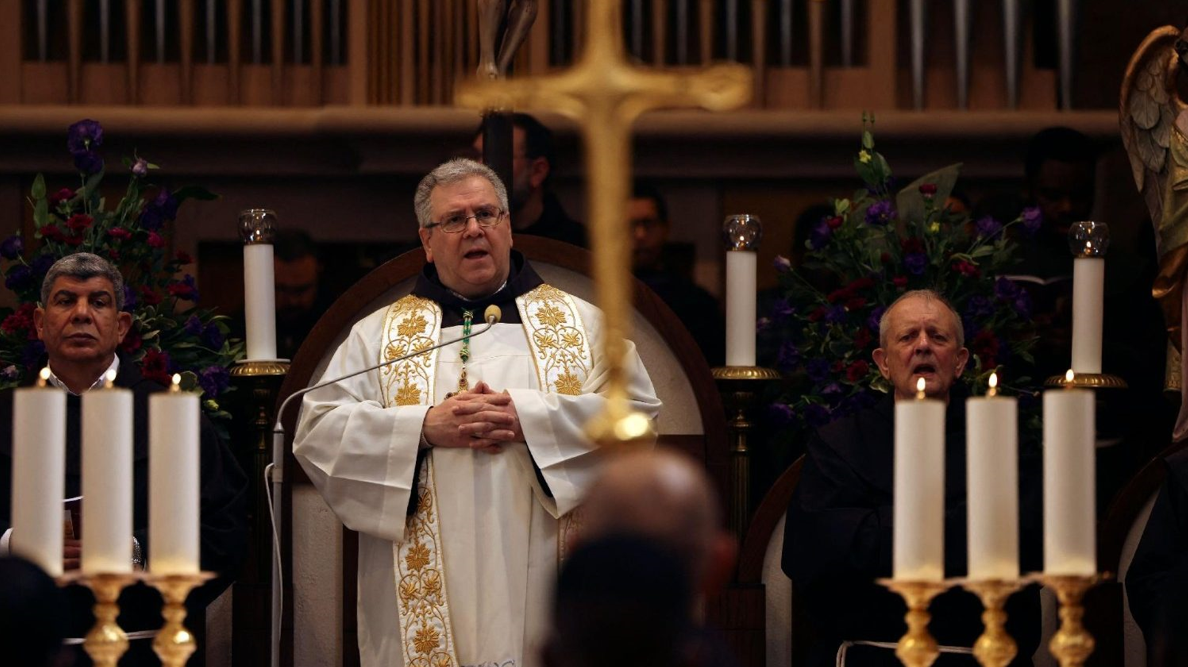
File photo of Father Francesco Patton (AFP or licensors)
Father Francesco Patton, author of the meditations for the Pope's Good Friday 'Via Crucis' at the Colosseum in Rome, notes that even today, many people are living a Way of the Cross.
By Roberto Cetera
“In the reflections and prayers, the inspiration from current reality and from concrete people is evident,” particularly from the sufferings of Christians in the Middle East due to the war.
In this way, Father Francesco Patton of the Order of Friars Minor, summarized the origin of the meditations written for the Way of the Cross that will be presided over by His Holiness Pope Leo XIV at the Colosseum on Good Friday evening.
In the following interview with Vatican News, Fr. Patton, who served as the Custos of the Holy Land from 2016 until June 2025, explained how the Pope’s choice coincided with the eighth centenary of the death of St. Francis of Assisi.
Q: Father Patton, the Pope entrusted you with the writing of the meditations that will accompany the Good Friday Way of the Cross at the Colosseum. Is this an unequivocal sign of the Holy Father’s attention to the Holy Land and the tragedies afflicting the countries of the Middle East?
Since the day of his election, Pope Leo XIV has continuously invoked the gift of peace. He has expressed closeness and solidarity not only to the Holy Land but to all countries, peoples, and individuals suffering because of war.
This, after all, has been the Church’s line for over 100 years, since August 1, 1917, when Pope Benedict XV refused to bless the armies, defined the war being fought as an “useless slaughter,” and urged the leaders of the belligerent nations to reach a just and lasting peace through negotiation, respect for international law, the return of occupied territories, restoration of free movement, and disarmament to free resources to be invested in the common good and development.
Since then, the Church has always expressed closeness to populations devastated by war and repeatedly condemned armed conflicts, which continue to be an “useless slaughter.” Almost every Sunday after the Angelus and every Wednesday at the end of his catechesis at the General Audience, Pope Leo XIV has insisted on the necessity of achieving peace, not only in the Holy Land but in all countries currently involved in bloody wars.
Last Sunday, he used very strong words to reject violence perpetrated in the name of God, saying that God does not listen to the prayers of warmongers with hands stained with blood.
Q: I imagine receiving this invitation was a surprise for you.
A very big surprise, I would say. I was concretely contacted by the Secretariat of State, which told me that the Holy Father, in conjunction with the eighth centenary of the death of Saint Francis of Assisi, had instructed them to ask me to prepare the meditations.
The matter intimidated me but at the same time honored me.
Q: What inspired you most while writing these meditations?
I took inspiration from the Gospel texts, favoring the Evangelist St. John, who has a penetrating view of the mystery of the Lord’s Passion; and then from the “Writings” of Saint Francis, which are a treasure trove of Christian spirituality. In the reflections and prayers, it is evident that the inspiration also comes from current reality and from concrete people in whom, over these years, I have been able to see the characters of the Way of the Cross.
Where I speak about the suffering of mothers and women, women appear in watermark who have also been written about in L’Osservatore Romano and who today embody the figure of Mary, Veronica, and the women of Jerusalem.
Behind the reflection on the distorted conception of power and abuse of power there are international news events that are before everyone’s eyes; the Cyrenean has the face of many volunteers and humanitarian and communication workers whom I have met over these years and who risked their lives to care for someone or to make the truth known, without even being Christians.
The concrete situations named in the reflections do not want to trigger judgment on individual persons, but invite reflection, asking questions and — if necessary — even to change. The message is essentially religious and wants to express the closeness of Jesus Christ, as the incarnate Son of God, to every human person.
I tried to make the Way of the Cross at the Colosseum inspired by the Way of the Cross that we make every Friday along the Via Dolorosa and at the same time draw from the spirituality of Saint Francis to help believers “walk in the footsteps of Jesus” and non-believers discover that Jesus cares about each of us, and that in Him one can find hope and a reason for life even if it has been lost.
My desire is that, by encountering Jesus Christ and walking behind Him toward Calvary, every person may perceive His closeness and His love; perceive that Jesus Christ gave His life for each of us and wants to bring each of us “back to the Father” together with Him, to find life in its fullness thanks to Him and to live the human condition, which is finite and mortal, with the horizon of Easter, Resurrection, eternal life, and participation in God’s very life…
This interview was originally published on the Website of Vatican News. Please click here to read the full text.