
Maundy Thursday Homily of His Beatitude Patriarch Cardinal Pierbattista Pizzaballa
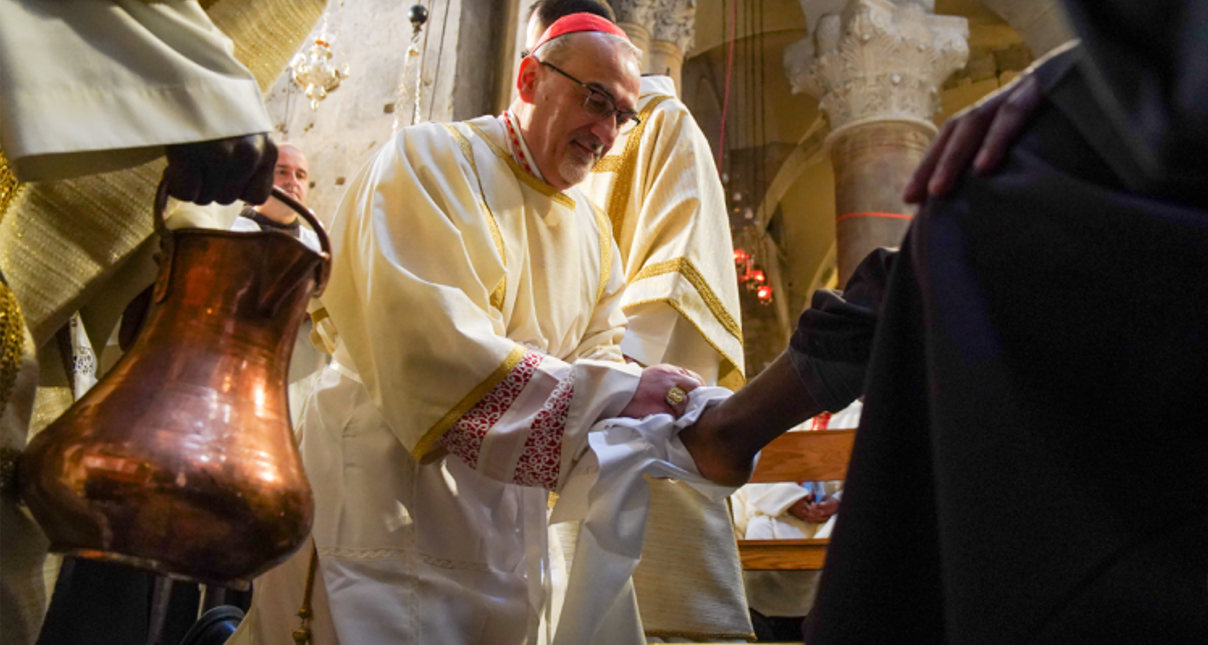
Below you can find the Homily of His Beatitude Patriarch Cardinal Pierbattista Pizzaballa, for Maundy Thursday 2026 - Jerusalem, Church of the Holy Sepulchre.
Ex 12:1-8, 11-14; 1 Cor 11:23-26; Jn 13:1-15
Dear brothers and sisters,
may the Lord give you peace.
We are in the place where a stone once sealed death. And yet today we are here to celebrate life. There is a tension we cannot ignore: outside, the doors of the Holy Sepulchre are closed. War has turned this place into a refuge, an “inside” cut off from an “outside” weighed down by fear and strain. We are here as within a womb of peace, while the world around us is being torn apart, and we wish we could change all of this.
And yet, here and now, the Word of God places before us a gesture that overturns all our human ways of thinking.
In the Gospel according to John, we read: “He rose from supper, laid aside his garments, and taking a towel, girded himself” (Jn 13:4). That verb – “to gird oneself” – echoes throughout Scripture. It is the same verb found in the Book of Exodus, when the Lord gives instructions for the Passover: “This is how you are to eat it: with your loins girded, sandals on your feet, and your staff in hand; you shall eat it in haste. It is the Lord’s Passover” (Ex 12:11).
To gird one’s loins, in the Bible, is the gesture of one who is preparing to set out. It is the gesture of one about to make an exodus, to leave the land of slavery and enter into freedom. That night, the people of Israel ate the lamb with their loins girded because they were about to go out. The belt was the sign of a passage at hand.
And now Jesus, at the hour of his own passage, girds himself. But he does not gird himself in order to depart. He girds himself in order to bend down.
This is the first thing we must truly see: Jesus transforms the gesture of one who sets out into the gesture of one who serves. In God’s logic, the Exodus is not a flight away from the world, but a descent into the world, all the way to its depths. The girded loins of Jesus are no longer the sign of one fleeing from slavery, but of one who freely makes himself a slave out of love.
For this reason, the washing of the feet is not a moral lesson, nor simply an edifying example, nor a tender scene. It is the concrete form of Jesus’ Passover. It is the way God passes through history. It is the way love chooses to enter the world.
And it is precisely here that our resistance emerges, embodied in Peter. When Jesus comes to him, Peter responds with blunt words: “You shall never wash my feet” (Jn 13:8). This is not merely modesty. It is refusal. It is the scandal of a love that lowers itself too much. Peter cannot accept a Lord who bends down.
But Jesus’ reply is even more uncompromising, and it is one of the most severe statements in the Gospel: “Unless I wash you, you will have no part with me” (Jn 13:8).
Jesus does not say, “If you do not accept this, you will no longer belong to me.” He says something far deeper: “you will have no part with me.” The word “part” does not indicate a role; it speaks of communion. It is the language of inheritance, the language of covenant. It is as if Jesus were saying: Peter, you may admire me, you may follow me, you may even defend me – but if you do not accept this way of loving, you will not enter into my passage. You will not share in my Passover.
Here lies the decisive point of this liturgy: Easter is not something Jesus does for us without us. It is something we can experience only with Him. And to live with Him, we must embrace His way of loving. There is no communion without that embrace. There is no “part” without allowing oneself to be served.
Peter, as so often happens, wants to set the conditions of love. He desires a love that saves without touching, that forgives without exposing itself, that frees without lowering itself. But Jesus says to him: unless I wash you, you will have no part with me. Because true love does not remain at a distance. It comes down. It touches. It exposes itself.
In this, we can all recognize ourselves. We too often wish for a God who would lift us up without unsettling us, who would restore our dignity without passing through our fragility. And yet today, here, we are asked to do something far more demanding: to allow ourselves to be loved to the very end. To let Christ bend down precisely where we feel shame. To let him enter our poverty, our inconsistencies, our sins. Only in this way can we truly have a part with him.
It is at this point that we also come to understand the Eucharist. Paul hands on to us Jesus’ words over the bread: “This is my body, which is for you” (1 Cor 11:24). “For you.” Not for himself. Not for self-assertion. Not to defend a cause. “For you” means a body handed over, a body given, a body that holds nothing back.
That body, at the supper, takes the form of a body that bends down. The Eucharist cannot be separated from the washing of the feet. They are not two different moments; they are two expressions of the same love. The body broken on the altar is the same body that kneels before the disciples. If we separate the two, we lose the meaning of both.
That is why we are called not only to adore, but to enter into a way of life. It is not enough to look upon Jesus as he bends down; we must decide whether we want to have a part with him. And to have a part with him means accepting that our own lives will be drawn into the very movement of his life.
After washing their feet, Jesus says: “If I, therefore, the Lord and the Teacher, have washed your feet, you also ought to wash one another’s feet” (Jn 13:14). This is not an added conclusion. It is an inevitable consequence. Those who have a part with him take on his form. Those who enter into his Passover also enter into his way of living.
All of this – As I said – does not arise from moral effort. It arises from an experience received. Only those who have allowed themselves to be washed can learn how to wash others. Only those who have accepted being loved in this way can love in this way. This is why the first conversion is not about doing something for others, but about ceasing to resist the love of Christ…
This Homily was originally published on the Website of the Latin Patriarchate of Jerusalem. Please click here to read the full text.