
Why Martyrs' Square Chosen for the Ecumenical Meeting with His Holiness Pope Leo XIV?
Media of the Middle East Council of Churches (MECC)
Martyrs' Square – a square that encapsulates the history and essence of Lebanon – was chosen in the heart of Beirut, a city that rose from its suffering to remain a beacon of peace and dialogue, and a permanent platform for encounter among the people of one faith and one humanity.
Martyrs' Square embodies coexistence among all the components of the nation. It has always been a space that brings together Lebanese people of all affiliations and honors all of Lebanon's martyrs who fell for freedom and national unity. Furthermore, the exceptional proximity between the Mohammad Al-Amin Mosque and the Maronite Cathedral of Saint George constitutes a unique symbol in the world of spiritual coexistence and interfaith dialogue.
This meeting is not merely a symbolic celebration, but a living embodiment of the spirit of Beirut, which has united people of all backgrounds with love and embraced their diversity as a unique human and spiritual value. Beirut Chants El-Sistema Choir, the Imam Musa Al-Sadr Foundation Choir, and the Islamic Orphanage Choir will participate in this gathering, performing beautiful hymns and chants specially composed for this event.
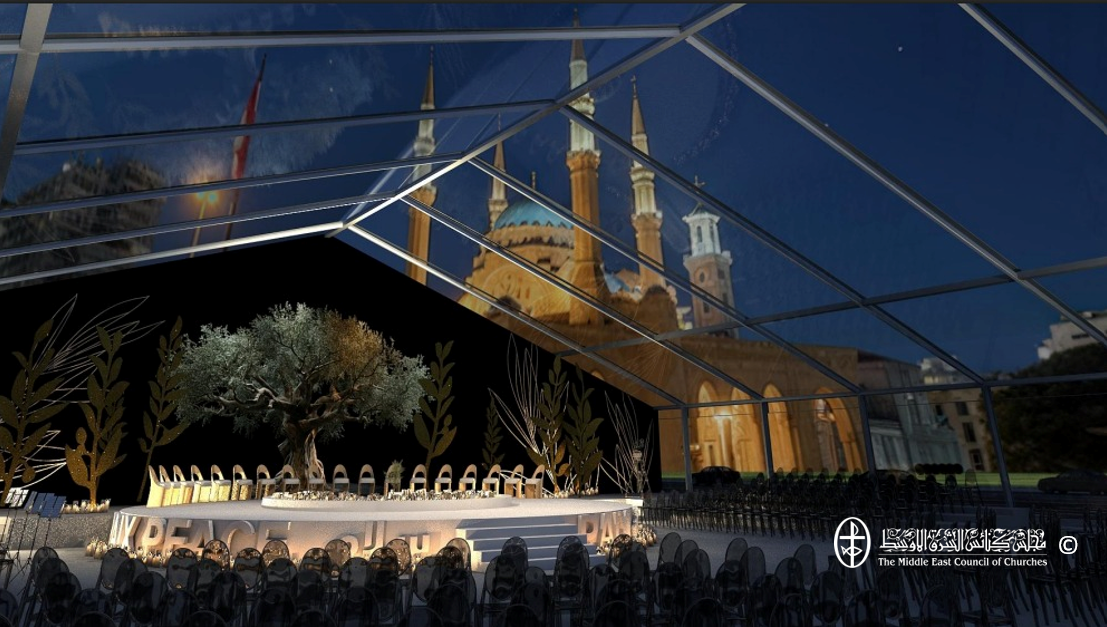
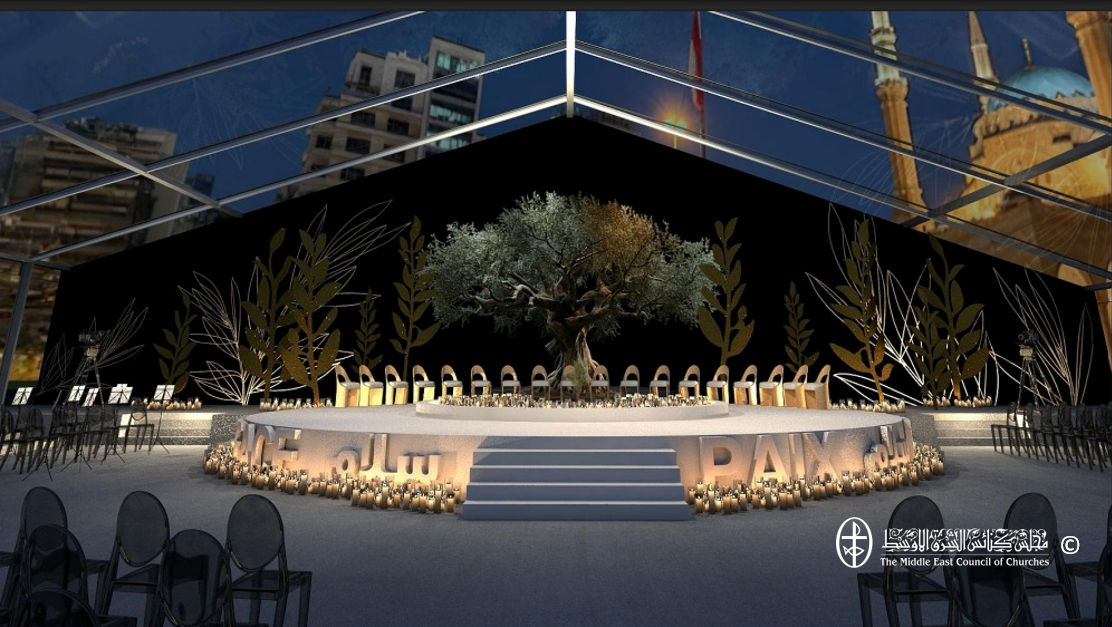
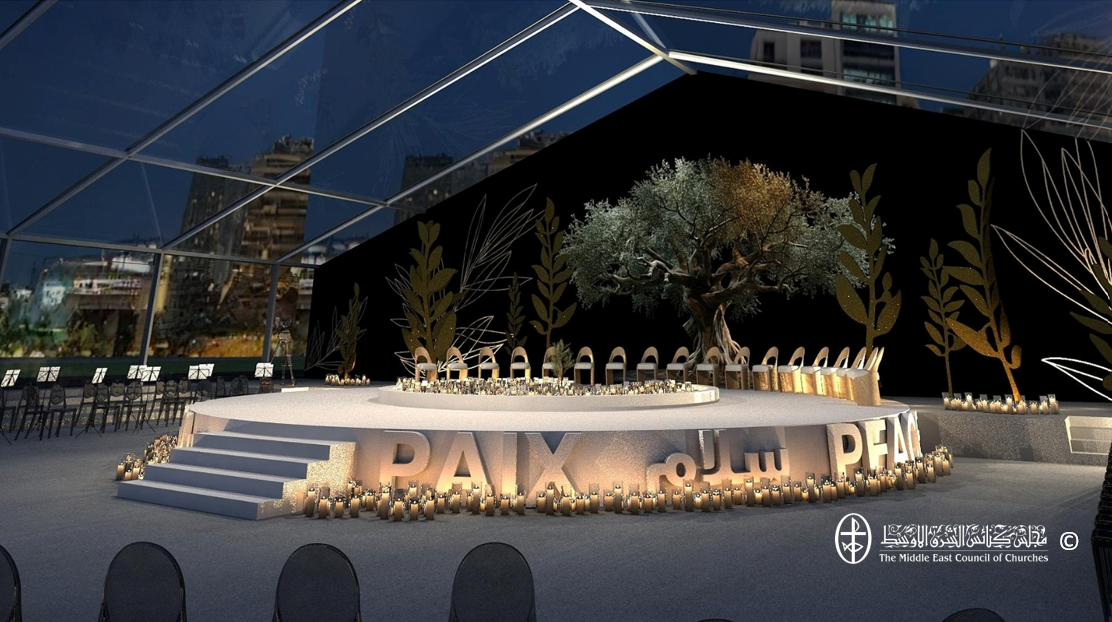
The concept of the meeting theater is composed of three fundamental symbols, each carrying a message that resonates with the Pope's visit: unity, peace, and hope.
The circular shape symbolizes unity, representing the eternal bond that unites all people, regardless of divisions in faith, culture, and heritage. It reminds us that, despite our differences, we all belong to the same human circle, united by shared values such as truth, love, and compassion.
Moreover, the olive branch symbolizes peace, deeply rooted in the land of Lebanon; the olive branch stands as an eternal symbol of peace and reconciliation. Its roots reflect the profound spiritual heritage of this region, while its branches extend outward, embracing diversity. Through the olive tree, the design honors Lebanon as a place of interfaith encounter, a place where Christians and Muslims together strive for harmony and mutual respect. It is a heartfelt call for peace that reaches out to the world.
The candle, a symbol of hope
At the heart of the design, a flame represents unwavering faith, even in moments of uncertainty, and the conviction that light will always triumph over darkness. The flame reflects the spiritual strength of the Lebanese people, who have always carried a message of resilience and love. Participants will gather around the flame, reminding them that hope is not lost, but rather renewed through faith and brotherhood.