
Courage to Continue the Journey Together
The Middle East Council of Churches Holds the First Day of Its Annual International and Regional Partners Meeting
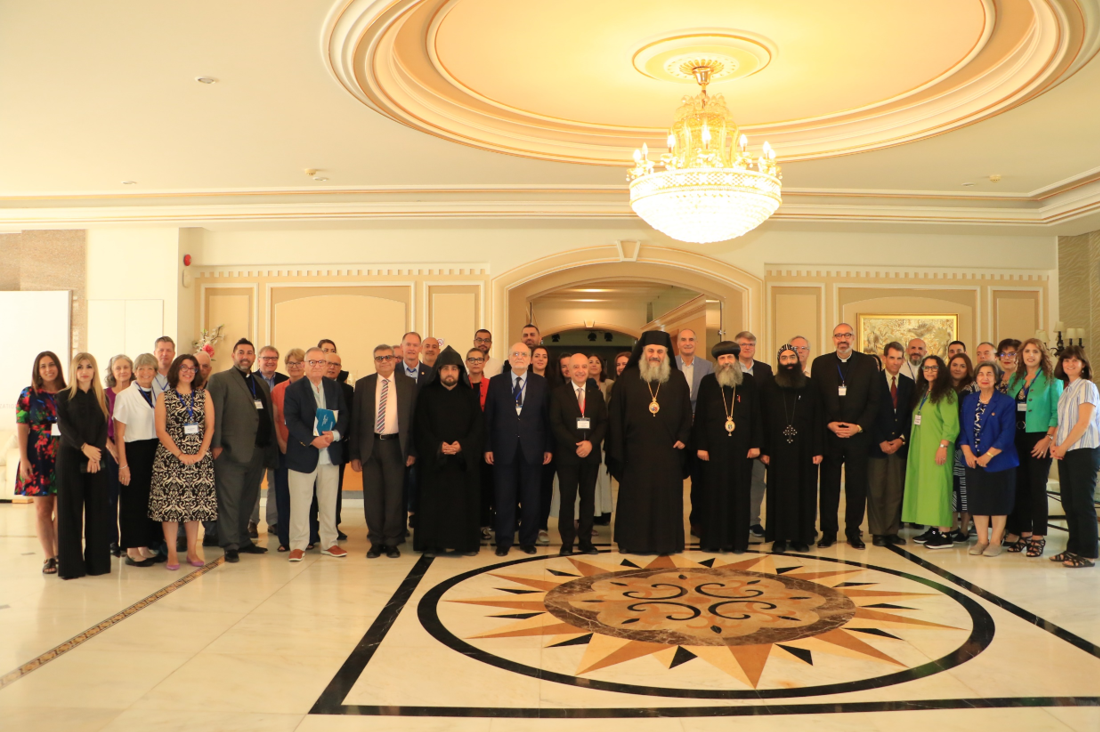
Under the title "Courage to Continue the Journey Together," the General Secretariat of the Middle East Council of Churches (MECC), headed by the Secretary General Professor Michel Abs, held the first day of its annual meeting with the MECC Partners from international and regional organizations and institutions, on Tuesday, September 10, 2025. The meeting continues until Wednesday, September 11, at the Liqaa Center in Rabweh, Lebanon.
Attendees were representatives of various partner organizations and institutions of the Middle East Council of Churches from around the world, His Eminence Metropolitan Antonios Al Soury, Greek Orthodox Metropolitan of Zahle, Baalbek and their Dependencies, representing His Beatitude Patriarch John X, Greek Orthodox Patriarch of Antioch and All the East, and MECC President for the Orthodox Family, and Reverend Dr. Paul Haidostian, President of the Union of the Armenian Evangelical Churches in the Near East (UAECNE), President of Haigazian University in Lebanon, and MECC President for the Evangelical Family.
Attendees were also MECC Associate Secretaries General, as well as the directors and coordinators of the MECC departments and the team.
The meeting began with a Prayer and an opening speech by Reverend Dr. Paul Haidostian, who said: “the partners meeting is not simply an administrative occasion for reporting. It is a time for self-reflection and some analysis…”. He added, “In the spirit of gratitude, we celebrate our common identity and calling as people of Christ… A call for humanity. In Christ, God made us alive together…”.
He continued, “In a region that has known conflicts wars genocides... this truth becomes more urgent that we are raised with Christ together. Our calling is to witness to this unity through Prayer and service…”.
Then, the MECC Secretary General Professor Michel Abs delivered a speech entitled “On Spiritual Partnership and Institutional Policies,” in which he said, “I wish to affirm, as someone active in the ecumenical movement since 1981, that the Church and the ecumenical bodies it inspired played a decisive role in these cultural shifts in the West, shaping how peoples view various issues and thorny questions on regional and international stages. What concerns us today is the shift in financial support policies adopted by institutions in industrial surplus societies…”
He added, “I must express my joy at welcoming true partners in every sense of the word, where spiritual partnership, mutual love, and shared values—shaped through decades of maturation—carry the same weight as material partnership through project funding or financial support in general… Dignity is among the most important commandments of the Savior, embodied in all He said and did, and we must be instruments for its preservation.”
In the first session, two speeches were delivered by His Excellency the Lebanese Minister of Information Lawyer Dr. Paul Morcos, and His Excellency Lebanese MP Mr. Neemat Frem, under the title "The Middle East at a Crossroads of a New Shape Land and Identity." They addressed the social, economic, and security conditions that the Middle East is facing, as well as the most prominent causes that have led to the deterioration of living conditions in the region, which has imposed enormous daily challenges and pressures.
Moreover, Dr. Peter Makari representing Global Ministries and the United Church of Christ and the Christian Church, and Mr. Dick Loendersloot representing Kerk In Actie, delivered two speeches on the reality of the Middle East from the perspective of the West, highlighting their aspirations to build better societies for the people of the region.
In the second session, the MECC Secretary General Professor Michel Abs presented his report, which included all the activities, programs, and projects implemented. He addressed the challenges that MECC faced in its work and ways to address them with great hope and deep faith. He also spoke about his vision for the coming period and the challenges facing it in achieving its desired Ecumenical and humanitarian goals.
The third and fourth sessions included reports from the departments and divisions, which centered around the projects and achievements of the Finance Department, the Theological and Ecumenical Department, the Association of Theological Institutes in the Middle East (ATIME), the Diakonia and Social Service Department, the Department of Service to Palestinian Refugees (DSPR), the Communication and Public Relations Department, the “Social Cohesion and Human Dignity” Programs, the Human Resources Department, and the Procurement Department.
The first day concluded with a closing Prayer. The meeting provided an Ecumenical space for exchanging views and experiences, with the aim of developing working mechanisms to achieve the desired goals and working together towards a more effective future partnership.