
On the 111th Commemoration of the Armenian Genocide
Reverend Dr. Paul Haidostian to the Middle East Council of Churches:
Rootedness in land and identity led to the genocide
We renew our commitment to be children of God, preserving the human dignity of every person and every people
Media of the Middle East Council of Churches (MECC)
Amidst all the challenges of life and the escalating daily crises, the 111th Commemoration of the Armenian Genocide comes carrying much hope and faith, reinforcing a cry for truth and justice from hearts that have not yet healed.
Yet they are hearts determined to remain, to stand firm, and to exist. Hearts that chose to preserve Armenian identity, continuing the journey of their forefathers through witness, generosity, and the preservation of spiritual, moral, and social values.
The cause of the Armenian people remains an ongoing cause for future generations, and a beacon for Prayer, solidarity, and determination.
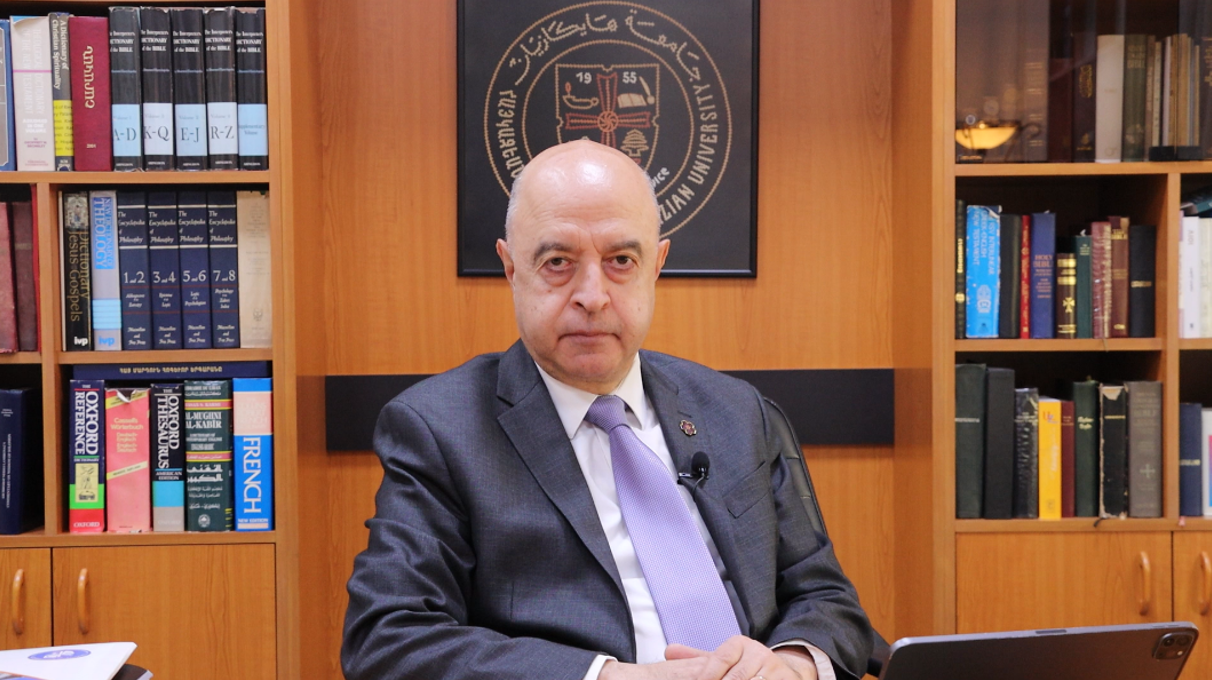
On the 111th Commemoration of the Armenian Genocide, the Middle East Council of Churches (MECC) held a special video talk with Reverend Dr. Paul Haidostian, President of the Union of the Armenian Evangelical Churches in the Near East (UAECNE), President of Haigazian University in Lebanon, and President of the Middle East Council of Churches (MECC) for the Evangelical Family. This video was part of a special media episode commemorating the massacres against the Armenian people, entitled "Keeping Memory Alive," produced by the Middle East Council of Churches.
At the beginning, Dr. Haidostian noted: “As Armenians, non-Armenians, and minorities in this region, we commemorate the 111th year of the Armenian Genocide, a Genocide that lasted for many years.”
He added: “On this Commemoration, we honor those whose daily, national, and collective lives were taken by force from this land. After honoring them, we remember that those who died and were martyred are not numbers. They are my grandparents, your grandparents, and others’ grandparents. They are people who bore powerful witness in their lives and faith, and it was their rootedness in their land and identity that led to this genocide.”
He continued, stressing the need to preserve human life, because it is “a fundamental pillar in the world, especially in ethics, thought, and Christian Theology. Human life is a gift from God. Respecting every person who possesses this life, this soul as a gift from God, means that every human life is a divine gift and a treasure. We must not strip people of their lives, their spirit, or their history. Rather, it is essential to honor every human being, for we are all God’s creation.”
In this context, Dr. Haidostian emphasized: “Genocide cannot be justified in any way. People say there are wars, injustice, killing, and death in life. But no, every genocide of people stems from a specific idea, a particular policy, and oppression and aggression against human identity. It is not an accidental event caused by difficult circumstances. Genocide is an evil decision, deliberately directed at people or a force in this world. Therefore, it is necessary to call genocide by its name.”
He also pointed out that: “Today, on this Commemoration, we stand before the Lord Jesus Christ, who gave His life on the cross. He shed His blood so that we would not lose the human value in our lives, the value that comes from Jesus Christ and from God’s creation. Good comes from God, while evil arises from our selfishness and the evil that resides within us.”
At the end, Reverend Dr. Paul Haidostian said: “I call for repentance, the repentance of those who do not acknowledge the genocide or the evil they have committed, and the repentance of every person for all forms of evil in this world. For we are sons and daughters of the new creation in Jesus Christ. Therefore, let us work today with all our abilities, as Christians and as Armenians, so that we do not allow any genocide that may occur to pass easily. In humility before this Commemoration, we renew our commitment to be children of God, preserving the human dignity of every person and every people. May God bless us all.”