
In Wadi El Natrun: GETI Conference Calls Churches to Remember, Resist, and Rebuild Amid Persecution and Suffering
— Wadi El Natrun, October 15, 2025
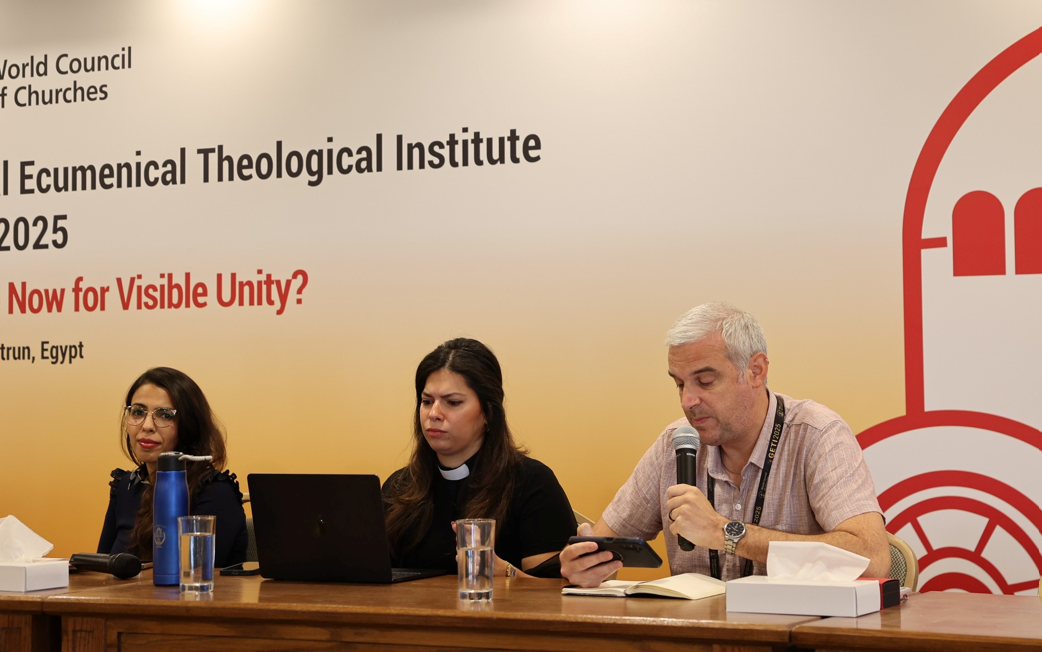
In the heart of the Egyptian desert, within the ancient walls of the Monastery of Saint Bishoy—where prayer and history intertwine—participants of the Global Ecumenical Theological Institute (GETI), affiliated with the World Council of Churches (WCC), gathered on October 15 for a plenary session entitled “Memory and Mission: Churches Responding to Persecution and Genocide.”
The session formed part of the in-person phase of GETI, held concurrently with the World Conference on Faith and Order.
The session opened with a clear call for churches to reflect on their role in remembering the suffering of peoples, bearing a message of hope, and confronting persecution with faith and steadfastness.
Speakers included Prof. Grace Al-Zoughbi, professor of theology at Bethlehem Bible College, and His Beatitude Cardinal Pierbattista Pizzaballa, Latin Patriarch of Jerusalem, who delivered his remarks through a recorded message.
The session was moderated by Rev. Sally Azar of the Evangelical Lutheran Church in Jordan and the Holy Land, and Rev. Dr. Graham Gerald McGeoch, WCC Programme Executive for Mission.
In her academic and spiritual presentation, Dr. Al-Zoughbi addressed the realities of fragmentation, displacement, and steadfast faith among Christians in the Middle East within the broader scope of Christian memory worldwide.
She emphasized that the decline of Christianity in the region goes beyond mere numbers and touches a profound theological dimension.
She stated:
“These communities were once vibrant actors in the diverse ecclesial and social life of the region. Today, however, they face an erosion that threatens not only their ecclesial continuity but also the stability of Middle Eastern societies as a whole. Christianity here—deeply rooted in a rich historical and cultural heritage—has become increasingly marked by signs of dispersion.”
She added:
“The decline of Christianity in the Middle East is not simply a numerical or demographic crisis but a deep theological wound that weakens the church’s capacity for resilience, diversity, and continuity.”
Dr. Al-Zoughbi called for the renewal of education as a tool for reconstruction, affirming:
“Locally, to preserve heritage; regionally, to strengthen bonds of solidarity; and globally, to reintegrate forgotten voices into the universal Christian consciousness.”
In his recorded message, His Beatitude Cardinal Pierbattista Pizzaballa expressed hope that the first step achieved between Hamas and the Israeli government could mark the beginning of a new stage of understanding, describing it as “an important step.”
The Cardinal said:
“We all know that we needed this. I understand that we are here to talk theology, but theology must take flesh in the reality we live.”
He acknowledged that the situation remains tragic, especially in Gaza, yet he insisted on rejoicing in any sign of hope, stating:
“Any progress, however small, can represent the beginning of overcoming hatred and exclusion.”
He also warned against the “teaching of contempt,” which fuels division and strips the other of humanity, urging the promotion of a culture of dialogue, reconciliation, and genuine peace built upon justice and mutual respect.
The session concluded in an atmosphere of reflection and prayer, as participants expressed their deep appreciation to the Coptic Orthodox Church for hosting this significant ecumenical event at one of its most sacred monastic sites.
Speakers affirmed that the church is called today—more than ever—to remember its wounds, resist evil through faith, and rebuild its mission in the world with the spirit of hope.
Thus, the GETI Conference in Wadi El Natrun became a meeting point between memory and renewal, between suffering and hope, between an afflicted East and a compassionate West—reaffirming that Christian faith remains unconquerable as long as it is rooted in love, hope, and truth before God and humanity.
Click Here to Check the Photos.
This text was originally published on the Facebook Page of Ecumenical News.