
The Sunday of Thomas at the Greek Patriarchate of Jerusalem
From the General Secretariat of the Greek Patriarchate of Jerusalem
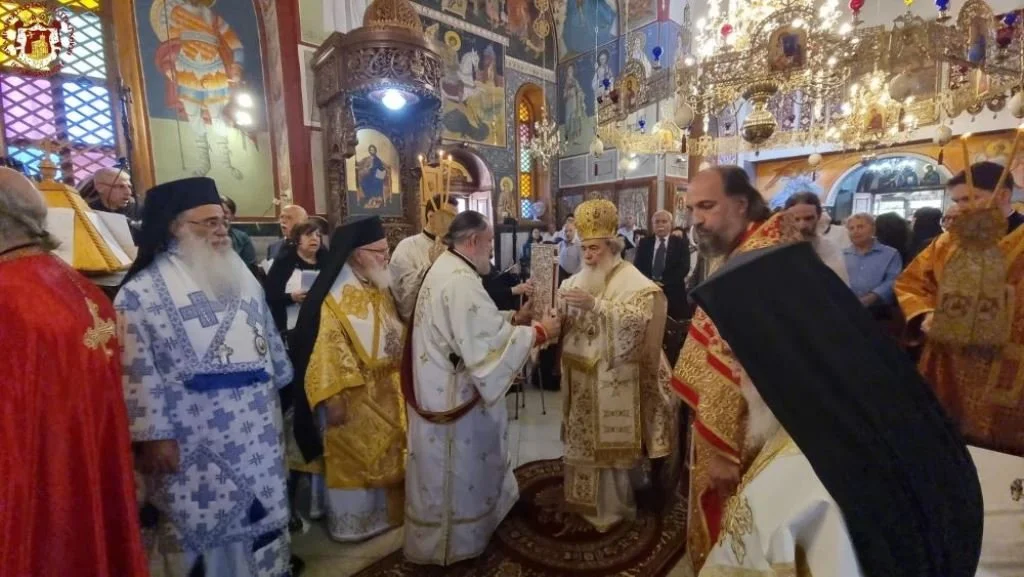
On Sunday, the 14th/27th of April 2025, the Patriarchate celebrated the Sunday of the Holy Apostle Thomas, that is, the event of the touching of the Lord by the Apostle Thomas, according to the Typikon of the Church and the established Status Quo. On this Sunday, eight days after Pascha, the Church commemorates that on the eighth day from the Resurrection, the Lord, “the doors being shut,” entered “into the upper room where the disciples were assembled.” Thomas was also “with them,” and he beheld the Lord and the marks of the nails in His hands and His side, and was convinced, exclaiming, “My Lord and my God.” (John 20:24–29, KJV).
This Paschal event of the appearance of the Risen Lord was celebrated by the Patriarchate:
A. At the Church of the Holy Sepulchre, as a “Parhesia,” that is, with a festive Vespers service in the evening, including an entrance and veneration at the Holy Deposition and the Holy Sepulchre, the offering of incense, the Great Entrance, and the blessing of bread at the Catholikon, and with the celebration of the Divine Liturgy in the morning at the Most Holy and Life-giving Tomb. The Patriarchal Commissioner, His Eminence Metropolitan Isychios of Capitolias, presided, concelebrating with His Eminence Archbishop Theophanes of Gerash and His Eminence Archbishop Theodosios of Sebastia, along with Hieromonks of the Holy Sepulchre, led by the Master of Ceremonies, Archimandrite Bartholomew, and others. The chanting was led by Hierodeacon Symeon together with the students of the Patriarchal School of Zion, with the participation of members of the Greek community of Jerusalem and pilgrims from Greece, Cyprus, Russia, and Romania, who had remained for the Paschal period, in the presence of the Consul of Greece, Mr Petros Anagnostaras.
After the Divine Liturgy, the customary ascent to the Patriarchate followed, along with His Eminence’s festal wishes and festive hospitality.
B. At the Holy Monastery of Saint George in the village of Cana of Galilee.
The feast was presided over by His Beatitude Patriarch Theophilos III, Greek Orthodox Patriarch of Jerusalem, who was received at the entrance by Scouts and Priests vested in front of the Holy Church of Saint George of the Holy Monastery of Cana. Concelebrating with Him were His Eminence Metropolitan Kyriakos of Nazareth, the Elder Chief Secretary His Eminence Archbishop Aristarchos of Constantina, His Eminence Archbishop Aristovoulos of Madaba, the Dean Priest Archimandrite Nektarios, the Representative of the Patriarchate of Moscow, Archimandrite Vassianos, Priests and Deacons of the Holy Metropolis of Nazareth, Archdeacon Mark, and Hierodeacon Eulogios. The choir of the parish chanted hymns in Greek and Arabic. A devout Orthodox congregation from Cana and the surrounding towns, together with reverent pilgrims, attended, honoured by the presence of Her Excellency the Ambassador of Greece to Israel, Mrs Maria Solomou, and His Excellency the Ambassador of Russia to Israel, Mr Viktor Anatolyev.
His Beatitude preached the divine word to the pious congregation as follows:
“This beginning of miracles did Jesus in Cana of Galilee, and manifested forth his glory; and his disciples believed on him” (John 2:11).
Dear brothers and sisters in Christ,
Pious Christians and pilgrims,
The Grace of the Holy Spirit hath gathered us all together on this blessed Paschal day, that we may celebrate, on the one hand, the three-day Resurrection from the dead of our God and Saviour Jesus Christ, and on the other hand, His presence, together with His Mother, at the wedding feast which took place here in Cana of Galilee.
During His presence at the wedding, Jesus began His miracles and manifested His glory, as Saint John the Evangelist declares. The beginning of the miracles which Jesus wrought was the changing of the water into wine, according to the true testimony of the governor of the feast, “who tasted the water that was made wine” (cf. John 2:9). Moreover, the honourable estate of marriage was sanctified, and the curse upon women was lifted. The children of women are no longer born in sorrow and pain, for Christ blessed even this beginning of our generation.
It is noteworthy that the glory of our Saviour Christ shone forth as the rays of the sun; thus, His disciples were made steadfast in their faith, marvelling at the things that had come to pass.
Saint Cyril of Alexandria does not merely recount the miracles that took place at the wedding here in Cana of Galilee, but he proceeded to the “theoria”, that is, the deeper spiritual meaning of the mystery of marriage, saying: “Thus, the Word of God descended from the heavens, as the Lord Himself saith, to unite Himself to human nature as a bridegroom takes a bride, and to persuade it to bear the spiritual fruits of wisdom. Therefore, human nature is rightly called the bride, and our Saviour the Bridegroom, since Holy Scripture lifts up its language from human things to the comprehension of divine mysteries. And the marriage was celebrated on the third day, meaning in the latter times of this present age.”
And we may ask ourselves: why is it fitting that human nature be called “the bride” and our Saviour “the bridegroom”?
Because the Word of God, who descended from the heavens, took upon Himself human flesh from the pure blood of the Ever-Virgin Mary — that is, His human Body. And this Body is none other than the Church, of which Christ is the Head; and as the divine Paul preaches, Christ “loved the Church, and gave himself for it; That he might sanctify and cleanse it with the washing of water by the word, That he might present it to himself a glorious church, not having spot, or wrinkle, or any such thing; but that it should be holy and without blemish” (Ephesians 5:23–27)…
Click Here to Check All the Photos.
This news was originally published on the website of the Greek Orthodox Patriarchate of Jerusalem, click here to read more.