
Homily of His Beatitude Patriarch Cardinal Pierbattista Pizzaballa for the Erection of the Parish of Saint Nicholas in Cyprus
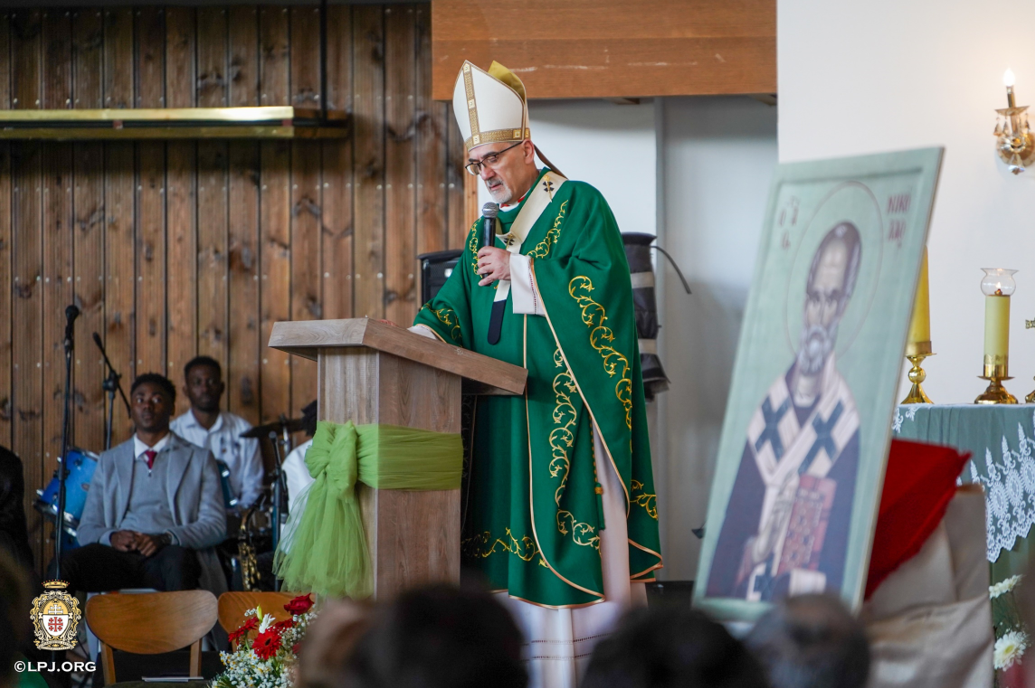
Below you can find the Homily of His Beatitude Patriarch Cardinal Pierbattista Pizzaballa, Latin Patriarch of Jerusalem, for the Erection of the Parish of Saint Nicholas in Cyprus, on Sunday 25 January 2026.
Third Sunday in Ordinary Time – Year A
Matthew 4:12–25
Dear brothers and sisters, members of the newly established community of Saint Nicholas,
dear priests, men and women religious,
dear all of you who today gather as the family of God,
The Word of God we have just heard could not be more fitting for this day of grace. It is not merely the account of a beginning in the past; it is a revelation of the way in which God, even today, brings His work to birth. And so, while the Church, in an act of trust and hope, establishes this parish, the Gospel sheds light on the deeper meaning of what we are living and celebrating.
The Gospel opens with a shadow: “When Jesus heard that John had been arrested…” The arrest of the Baptist is more than a chronological detail; it is a theological event. The prophet of preparation, the voice crying out in the wilderness, is silenced by the injustice and violence of power.
We might be tempted to think: a failure. God’s work has come to a halt. And yet, it has not. Precisely there, in that wound, the history of salvation changes pace, but it does not stop. John, the forerunner, exits the scene as every authentic witness does: by handing over his life to the truth he proclaimed. And Jesus takes up the torch. He too, as we know, will be “handed over.”
Brothers and sisters, this reveals something essential about the Church: she is never born from human triumph, but always from a fidelity that passes through trial. This community of yours, too, does not arise from nothing, nor from an already perfected ideal. There is nothing ideal in this parish, except your presence: no place, no spaces, nothinge else. It is born of a concrete history, shaped by expectations, patient journeys, and perhaps hidden sacrifices. Today, through this act, the Church proclaims that the Gospel continues to generate life precisely within the complex and not always reconciled stories of humanity.
And what does Jesus do in the face of this closure? “He withdrew to Galilee.” Notice the verb: not “He fled,” but “He withdrew.” It is the language of discernment, of prophetic choice. When a path appears blocked, the Son of God does not force the door; He seeks the opening that the Father reveals. And where is this opening? In Galilee of the Gentiles - a borderland, a peripheral region, mixed and diverse. Not the religious center of Jerusalem, nor the political center of Rome, but a crossroads of peoples, languages, cultures, and traditions, considered impure and insufficiently orthodox.
Here we see the genius of God: He chooses the periphery and makes it the center of His revelation. He chooses complexity and makes it the very face of His Church.
And so today a word resounds for you, the community of Saint Nicholas: you are a “Galilee” of our own time. Your community is marked by diversity - different origins, languages, cultures, and sensitivities. This is not a limitation to be overcome hastily. It is your identity; it is a grace; it is a sign of the times. The erection of this parish is an act of faith: the Church declares that she does not fear plurality, but embraces it as the privileged ground in which the Gospel can take flesh. Here, faith does not erase differences, but baptizes them, purifies them, and directs them toward communion. Here, no one is a stranger any longer, for we are all pilgrims called by the same Lord.
It is also an act of courage. In this land of Cyprus – so beautiful, yet wounded - this decision expresses the determination not to allow wounds and divisions to shape our choices. Instead, we desire to be a leaven of unity and of life.
Having settled in Capernaum, Jesus begins His proclamation: “Repent, for the Kingdom of heaven is at hand.” Yet Matthew immediately shows us that this Kingdom is not an abstract manifesto. It takes flesh in personal calling. Jesus walks along the sea, enters the ordinary lives of fishermen, looks at them, calls them by name: “Simon, who is called Peter, and Andrew his brother… James and John.”
The first work of the Kingdom is relationship: a gaze, a word, an invitation - “Follow me.” This is the foundation of everything.
The parish that comes into being today is not, first and foremost, an administrative structure or a geographical territory. It is, above all, a community convoked by the Word of God. A place where, through the mediation of brothers and sisters, each person can feel seen and called by Christ - by name, with his or her own unique history, language, wound, and gift.
And the promise is beautiful: “I will make you fishers of men.” What does this mean, especially in a “Galilee” such as yours?
The fisherman of Galilee did not work alone. He worked in a boat, with a net, as part of a team. To be “fishers of men” means: to have patience, waiting for the right moment; to work together, because the net is heavy and must be drawn in by many hands; to care deeply for what is caught, bringing it into the light, into salvation, into fullness of life.
In a plural community such as yours, the parish is called to be precisely this: a school of this art. A school of communion, where one learns the patience of listening, the effort of dialogue, and the beauty of mutual service. A place where faith is translated into respect, into attentive care for those who are fragile, lost, or weary. A mission that does not impose itself, but offers itself; that does not divide, but reconciles; that does not homogenize, but unites in Christ.
The prophet Isaiah, quoted by Matthew today, speaks of a “people who dwelt in darkness” who have seen “a great light.” This light is Christ. A light that does not magically erase the shadows of history—difficulties, misunderstandings, the fatigue of building together—but a light that guides, accompanies, and makes the journey possible.
This Parish of Saint Nicholas is called to be such a reflection of that light: a discreet, faithful, welcoming light. A light that illuminates without dazzling. A light kindled in the Eucharist, diffused through fraternal charity, and shining in a hope that does not disappoint.
Dear brothers and sisters,
the passage concludes with Jesus moving throughout all Galilee, teaching, healing, and proclaiming. It is an unstoppable movement: it begins with Him, passes through the disciples, and reaches the crowds. This is the very dynamism of the Church: from the Lord, to the community, to the world…
This Homily was originally published on the Website of the Latin Patriarchate of Jerusalem. Please click here to read the full text.