
His Holiness Pope Leo XIV at Audience: The Church's humanity and divinity are in harmony
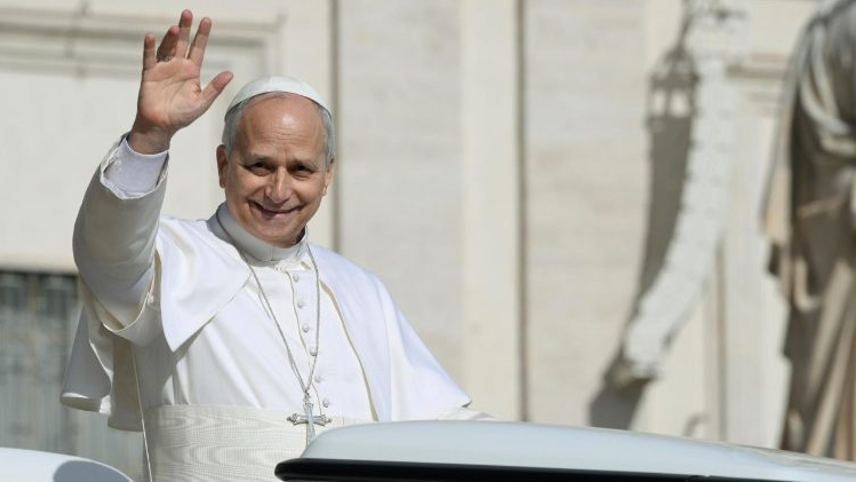
His Holiness Pope Leo XIV at Wednesday General Audience (@Vatican Media)
During his weekly General Audience, His Holiness Pope Leo XIV continues reflecting on 'Lumen gentium,' suggesting there is no opposition between the human and divine dimensions of the Church, and reminding that the Church is not some ideal apart but that of Christ throughout history.
By Deborah Castellano Lubov
"An ideal and pure Church, separated from the earth, does not exist; only the one Church of Christ, embodied in history."
His Holiness Pope Leo XIV expressed this during his weekly General Audience in the Vatican on Wednesday morning.
This week, the Holy Father continued reflecting on the Second Vatican Council's Dogmatic Constitution Lumen gentium, considering how the document presents the mystery of the human and divine dimensions of the Church.
While the first chapter was primarily intended to answer the question of what the Church is, and describes Her as a “complex reality,” Pope Leo said we now ask ourselves what this complexity consists of.
Human fragility and the divine
Lumen gentium, the Pope went on to say, affirms that the Church is a well-organized body, in which the human and divine dimensions coexist without separation and without confusion.
The Church, he noted, is a community of men and women who share the joy and struggle of being Christians, with their strengths and weaknesses, who proclaim the Gospel and become a sign of the presence of Christ who accompanies us on our journey through life.
"Yet this aspect," Pope Leo said, "is not sufficient to describe the true nature of the Church, because it also has a divine dimension," which "does not consist in an ideal perfection or spiritual superiority of its members, but in the fact that the Church is generated by God’s plan for humanity, realized in Christ."
"Therefore," the Pope said, "the Church is at the same time an earthly community and the mystical body of Christ, a visible assembly and a spiritual mystery, a reality present in history and a people journeying towards heaven."
Dimensions harmoniously integrate
In fact, he emphasized, the human and divine dimensions integrate harmoniously, without one overshadowing the other.
"The Church," the Pope reminded, "lives in this paradox. She is a reality that is both human and divine, which welcomes the sinful man and leads him to God."
In fact, he explained that Lumen gentium refers to the life of Christ to illuminate this ecclesial condition. "Those who met Jesus along the roads of Palestine experienced His humanity, His eyes, His hands, the sound of His voice. Those who decided to follow Him were moved precisely by the experience of His welcoming gaze, the touch of His blessing hands, His words of liberation and healing."
"At the same time, however, by following that Man," he continued, "the disciples opened themselves to an encounter with God," for "Christ’s flesh, His face, His gestures and His words visibly manifest the invisible God."
What constitutes holiness
The Pope, therefore, went on to examine the Church in the light of the reality of Jesus. "When we look at Her closely, we discover a human dimension made up of real people, who sometimes manifest the beauty of the Gospel and other times struggle and make mistakes like everyone else. However, it is precisely through Her members and Her limited earthly aspects that Christ’s presence and His saving action are manifested."
The Holy Father recalled when His Holiness Pope Benedict XVI had told Swiss Bishops at the beginning of his pontificate, "there is no opposition between the Gospel and the institution." "On the contrary," Benedict said, "the structures of the Church serve precisely for the realization and concretization of the Gospel in our time”…
This report was originally published on the Website of Vatican News. Please click here to read the full text.