
Freedom of Conscience and Responsible Faith
A Lecture By Reverend Dr. Paul Haidostian
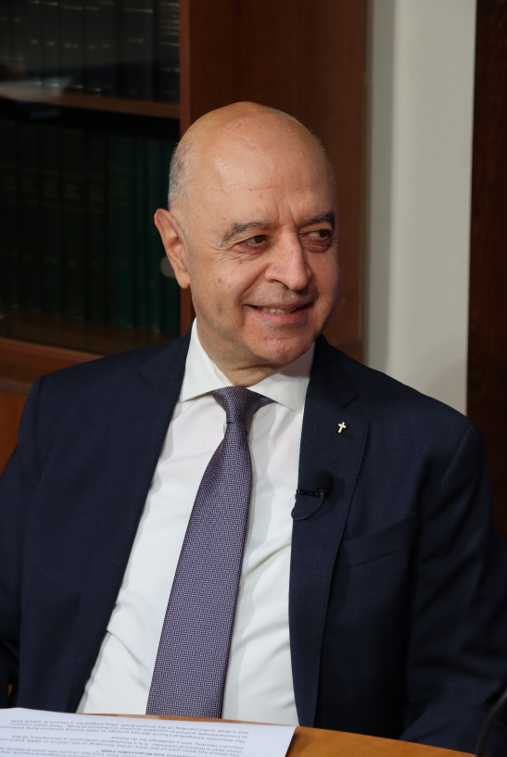
Reverend Dr. Paul Haidostian is the President of the Union of the Armenian Evangelical Churches in the Near East (UAECNE), President of Haigazian University in Lebanon, and President of the Middle East Council of Churches (MECC) for the Evangelical Family, delivered this lecture at a webinar organized by the Middle East Council of Churches, entitled “Freedom of Conscience and Responsible Faith,” on Thursday, July 23, 2026.
I thank the Middle East Council of Churches for this meaningful opportunity and pray that its media ministry be enriching for the life of the church in our region and also globally.
Why Freedom of Conscience Matters Today
On the occasion of the 180th anniversary of the Armenian Evangelical Church, the Union of Armenian Evangelical Churches in the Near East has chosen the central theme of "Freedom of Conscience and Responsible Faith."
The theme has been part of the story of the founding of our church in 1846, but is much more than a historical reminder. It is a theological confession, a description of the Church's identity, and a challenge for its future.
The Armenian Evangelical Church did not emerge in 1846 merely because forty believers in Constantinople wished to establish another ecclesiastical body. Their main concern was a deep understanding of the Gospel itself. They longed for a Church in which faith would be personal not only inherited, that it would be strongly biblical and freely sincere. In a foundational statement, they declared that freedom of conscience was more precious than social obedience and institutional authority, because only a conscience in service of Christ can genuinely worship God.
One hundred and eighty years later, this conviction remains very relevant. Indeed, it may be even more urgent today than it was in the nineteenth century.
As I present this reflection, I have in mind all of the following:
• Christians and non-Christians living under unjust governments.
• Churches facing political polarization.
• Christians identifying themselves with a church but with no regard for personal commitment, accountability, but simply pleasing church systems or expressing social religiosity to please society.
• Young people, including those in our Church Sunday schools and youth groups navigating social media pressure, and image crises.
• Believers experiencing ideological conformity.
• AI increasingly influencing moral decision-making
• The fear of expressing convictions, on the right or the left, even in democratic societies.
• Narrow religious nationalism in different parts of the world.
• Secular and globalized pressure to privatize or undermine faith.
The Biblical Foundation: Freedom and Responsibility
The Apostle Paul's letter to the Galatians provides the theological foundation of this vision. His concern was not simply circumcision or Jewish ceremonial law. His concern was the temptation of every generation to replace the freedom of the Gospel with systems that promise security but ultimately enslave the human spirit. "For freedom Christ has set us free" (Galatians 5) is not merely an invitation to personal independence; it is the declaration that salvation rests entirely upon God's grace in Jesus Christ. Christian freedom begins with liberation from the impossible burden of trying to justify ourselves before God or before others.
Yet Apostle Paul immediately introduces an equally important qualification.
Christian freedom is never autonomous freedom. "Do not use your freedom as an opportunity for the flesh, but through love serve one another." The message is clear: freedom without responsibility becomes self-centered individualism. Responsibility without freedom becomes oppressive legalism. The Gospel of Christ refuses both extremes.
This balance between freedom and responsibility may be the Armenian Evangelical Church's humble contribution to contemporary Christianity, a topic that even we, as Armenian Evangelicals, do not reflect upon sufficiently.
The modern world speaks constantly about freedom. We celebrate freedom of speech, freedom of choice, freedom of movement, freedom of expression, freedom of identity, freedom from occupation and hegemony, and freedom from external control. Yet much of this freedom has become detached from truth, responsibility, and moral discernment. Maybe put in simple form, freedom may mean doing whatever one desires, regardless of consequences or any sense of obligation.
A Christian Understanding of Freedom
The Christian understanding is profoundly different.
• Freedom is not the absence of authority; it is joyful submission to Christ.
• Freedom is not self-expression; it is Christ being formed within us.
• Freedom is not liberation from responsibility; it is liberation for faithful responsibility.
The Formation of the Christian Conscience
The Christian conscience therefore occupies a central place in Christian discipleship. Conscience is not simply personal opinion or individual preference. Neither is it merely an emotional feeling about right and wrong, about mine and yours. Biblically understood, conscience is the place where God's Word, the Holy Spirit, and the human person meet in moral discernment. A healthy conscience must continually be educated by Scripture, corrected by repentance, strengthened by prayer, and refined within the body of Christ, in the fellowship of believers.
This presents enormous challenges to today's Church.
Our generation, while blessed by many modern opportunities, faces pressures that earlier generations could scarcely imagine.
We are surrounded by overwhelming quantities of information but increasingly limited capacities for wise judgement.
We have unprecedented access to knowledge but declining habits of careful study and reflection.
We communicate constantly but have narrow opportunities to or time to listen carefully or even superficially.
We are connected digitally while becoming isolated morally and spiritually.
Even religious conviction can easily become shaped more by political ideology, social media, cultural trends, or charismatic religious or nonreligious personalities and influencers and celebrated figures than by the core message of the Gospel itself.
Perhaps one of the greatest dangers facing believers today is not persecution, often mentioned in the Bible, but distraction.
Christian Conscience
Now let us go back to the conscience.
Our consciences are being formed every day. The question is not whether they are being formed, but how and by whom.
Who teaches us what is true?
Who defines our priorities?
Who shapes our imagination?
Who tells us what success means?
Who determines what is just?
If the Church fails to answer these questions, countless other voices gladly will.
This concern becomes even more pressing as Artificial Intelligence rapidly transforms human decision-making. AI offers remarkable and welcome opportunities for research, education, management, medicine, and even Christian ministry. Yet nothing can replace moral responsibility. Algorithms may recommend decisions, but they cannot bear responsibility before God. Data can organize information, but how is it to produce wisdom? Artificial intelligence can simulate conversation, but it cannot exercise repentance, forgiveness, love, compassion, or worship.
The Church therefore faces a new educational responsibility.
We must cultivate believers who know how to think Christianly before they learn how to use technology effectively.
The future of the Church will depend not merely on digital competence but on spiritually formed consciences.
Freedom of conscience also requires intellectual humility.
The founders of the Armenian Evangelical movement valued Bible study, discussion, intellectual debate, education, publishing, and theological reflection because they believed that truth welcomes examination rather than fearing it. Genuine faith does not silence sincere questions. It does not suppress inquiry. It invites believers to seek understanding while remaining rooted in the authority of God's Word.
A related matter to all of this is how the church may lie our times in fear, physical, existential, intellectual, moral or other.
A fearful Church eventually becomes a fragile Church.
A confident Church welcomes honest questions because Christ Himself remains the Truth.
Contemporary Challenges to Responsible Faith
Responsible faith requires prophetic courage.
Throughout history, Christians have often spoken against persecution, injustice, discrimination, oppression, corruption, and violence because their ultimate loyalty belonged neither to governments nor to institutions but to Christ. Such prophetic witness remains indispensable today.
The Church cannot become merely another cultural organization seeking institutional survival. Whenever preserving ourselves and promoting our convictions becomes more important than bearing faithful witness to Christ, his love and our calling to serve others, we have exchanged the Gospel for mere security.
The Church must also exercise this prophetic voice toward itself, not only toward others.
Every anniversary should become an opportunity for self-examination rather than self-congratulation.
The question is never simply whether we have survived.
The question is whether we remain faithful.
Do our churches produce mature disciples of Christ or merely loyal members?
Do our institutions cultivate conviction or merely belonging and conformity?
Do our worship services enrich and inspire lives or simply preserve traditions?
Do our educational ministries develop Christian wisdom or only transfer information and produce diploma holders?
Do our leaders encourage thoughtful and humble discipleship or passive dependence?
These questions are uncomfortable. They are also necessary.
The Armenian Evangelical Church, today counting more than 100 congregations globally, possesses an extraordinary history of educational ministry, Bible translation, publishing, evangelism, humanitarian service, and faithful witness under persecution, even Genocide. We rightly thank God for this remarkable legacy. Yet history itself cannot sustain the Church.
Every generation is invited to personally embrace the Gospel.
Every generation must rediscover freedom of conscience.
Every generation must practice responsible faith.
Our founders cannot believe for us. Our institutions cannot believe for us. Our traditions cannot believe for us.
Only living men and women, transformed by the grace of Jesus Christ, can continue the Church's witness.
Therefore, the celebration of 180 years should not simply inspire gratitude for what God accomplished through previous generations.
It should awaken renewed commitment for the generations yet to come.
Freedom Belongs to Christ
The future of the Armenian Evangelical Church or any church, will not ultimately depend upon its buildings, finances, publications, or organizational structures.
Its future depends upon whether it continues forming believers whose consciences belong to Christ alone, whose minds are shaped by Scripture, whose hearts are governed by grace, and whose lives demonstrate responsible faith through humble service.
Such believers will always be free.
Not because society grants them freedom. Not because institutions protect them.
But because Christ Himself has made them free.
That remains the enduring evangelical contribution to the universal Church.
It was true in 1846.
It is true in 2026.
Freedom of Conscience and Christian Unity
And a closing word about ecumenism in all of this.
As Armenian Evangelicals, we do not celebrate freedom of conscience as a possession that distinguishes us from other Christians. Rather, we celebrate it as a gift that enriches the entire Body of Christ. Every Christian tradition has preserved treasures that belong to all believers: the ancient churches remind us of continuity, sacramental life, and faithful endurance; the Evangelical tradition continually recalls the necessity of personal commitment of faith, the authority of Scripture, and the freedom of the believer before Christ. None of us embodies the fullness of Christ alone.
Authentic ecumenism therefore is neither the surrender of convictions nor the polite concealment of differences. Genuine Christian unity is built upon truth spoken in love, humility expressed in mutual listening, and the shared confession that Jesus Christ alone is Lord of His Church.
Freedom of conscience actually makes such unity possible.
Only believers who are secure in Christ can listen respectfully to one another without fear. Only churches confident in the Gospel can enter dialogue without anxiety. Only responsible faith enables Christians to distinguish between essential truths that unite us and secondary matters over which we may continue to disagree while remaining brothers and sisters in Christ.
This is especially urgent in the Middle East.
Our churches often carry different histories, traditions, liturgies, and theological emphases. Yet before our societies we bear one common witness to Christ. In a region wounded by conflict, sectarianism, displacement, and polarization, Christian unity is not a luxury; it is itself a testimony to the reconciling power of the Gospel.
Freedom of conscience therefore should never isolate us from one another. Properly understood, it frees us from fear, from defensiveness, and from institutional insecurity, enabling us to meet one another not as competitors but as fellow disciples gathered around the same Lord, nourished by the same Gospel, and sent into the same broken world.
Responsible faith reminds us that freedom reaches its highest expression not in defending ourselves but in serving others. As Paul writes, "Through love serve one another." It is precisely this union of freedom and responsibility that enables the Church to become both faithful in conviction and generous in communion.
And, by God's grace, all of this must remain true for every generation that follows.
Glory to God, the Father, Son, and Holy Spirit. AMEN.
Rev. Paul Haidostian, Ph.D.