
His Beatitude Patriarch Kyrios Kyrios Theophilos III celebrates the Divine Liturgy in the village of Turan in Southern Galilee
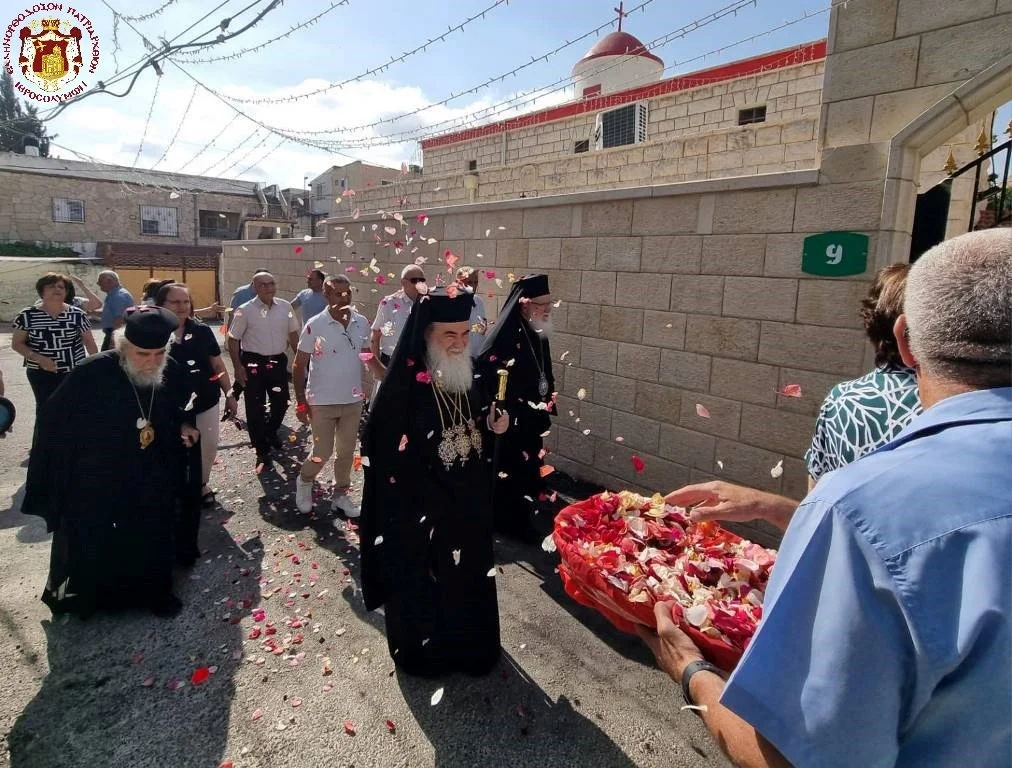
On Sunday, 19th May / 1st June 2025, the Sunday of the Holy Fathers of the First Ecumenical Council, His Beatitude Patriarch Kyrios Kyrios Theophilos III, the Patriarch of Jerusalem, visited the Community of Turan in Southern Galilee, located near the city of Nazareth, where He presided over the Divine Liturgy at the Holy Church of Saint George.
Concelebrating with Him were His Eminence Metropolitan Kyriakos of Nazareth and His Eminence Archbishop Aristarchos of Constantina, along with Hieromonks of the Brotherhood of the Holy Sepulchre, led by the Hegumen of the Holy Monastery of the Precious Cross in Jerusalem, Archimandrite Christodoulos, the parish priest Fr Ioannis, and other priests from the region, Archdeacon Mark, and Hierodeacon Eulogios. The devout faithful of the parish participated in the service, with the parish choir chanting.
Before the Holy Communion, His Beatitude preached the divine word with the following sermon:
“Let us extol today the mystic trumpets of the Spirit—the God-bearing Fathers—who composed in the midst of the Church a harmonious melody of theology: the one, unchanging Trinity in essence and Godhead. These are the vanquishers of Arius and champions of Orthodoxy, ever interceding with the Lord, that our souls may be saved,” the hymnographer of the Church proclaims.
Beloved brethren in Christ,
Pious Christians,
The grace of the Holy Spirit has gathered us all together in this sacred temple of your blessed city of Tur’an, in Lower Galilee, to commemorate the memory of the Holy 318 God-bearing Fathers who convened at the First Ecumenical Council in Nicaea of Bithynia, in the year 325 A.D.
The First Ecumenical Council, convened by the most pious Roman Emperor Saint Constantine the Great, condemned Arius’s blasphemous teachings, denying the divinity of the Son and Word of God, our Lord Jesus Christ, claiming that He was a created being.
The principal purpose of the Council was twofold: First, to condemn Arianism and provide an exact and Orthodox formulation of the Church’s dogmatic teaching concerning the Second Person of the Holy Trinity. Second, to proclaim the “Faith” or “Symbol” of Nicaea, commonly known today as the Nicene Creed.
In addition, the Council addressed and resolved three ecclesiastical schisms and brought an end to disputes regarding the date of the celebration of Pascha (Easter), decreeing that it should be observed on the first Sunday following the first full moon after the vernal equinox. Finally, the Council issued twenty sacred canons concerning Church order and discipline.
It is noteworthy that, as the esteemed Professor Ioannis Karmiris affirms, the One, Holy, Catholic, and Apostolic Orthodox Church ascribes to the dogmatic decisions of this First Ecumenical Council, and those of the subsequent six Ecumenical Councils, eternal validity, absolute authority, and universal and binding character. These are held as the chief written monuments of Holy Tradition, and as canonical, authentic, and immovable standards of Orthodox faith.
Accordingly, the Orthodox Church uses these Ecumenical dogmatic definitions as the primary and principal source of her dogmatic teaching, regarding them as equal in authority to the Holy Scriptures, since they contain the genuine Holy Tradition. Together with the Holy Scriptures, they constitute the two equally authoritative and balanced sources of Orthodox Faith.
This Sunday, the seventh after Pascha, is dedicated to the solemn commemoration of the Three Hundred and Eighteen (318) Holy Fathers of the Church who took part in the First Ecumenical Council in Nicaea of Bithynia. This is so because the God-bearing Fathers of the Church are the successors of the Holy Apostles and disciples of our Lord Jesus Christ.
To these Holy Apostles and His disciples, Jesus revealed the name of God His Father, as is testified in today’s Gospel reading from Saint John the Theologian, referring to the prayer of Jesus Christ to God the Father, in which He says: “Father, I have manifested thy name unto the men which thou gavest me out of the world: thine they were, and thou gavest them me; and they have kept thy word. Now they have known that all things whatsoever thou hast given me are of thee. For I have given unto them the words which thou gavest me; and they have received them, and have known surely that I came out from thee, and they have believed that thou didst send me” (John 17:6–8, KJV)…
This news was originally published on the website of the Greek Orthodox Patriarchate of Jerusalem, click here to read more.